 Skip to main content
Class A fire-rated materials: 7 Powerful Benefits in 2025
Why Class A Fire-Rated Materials Are Essential for Building Safety
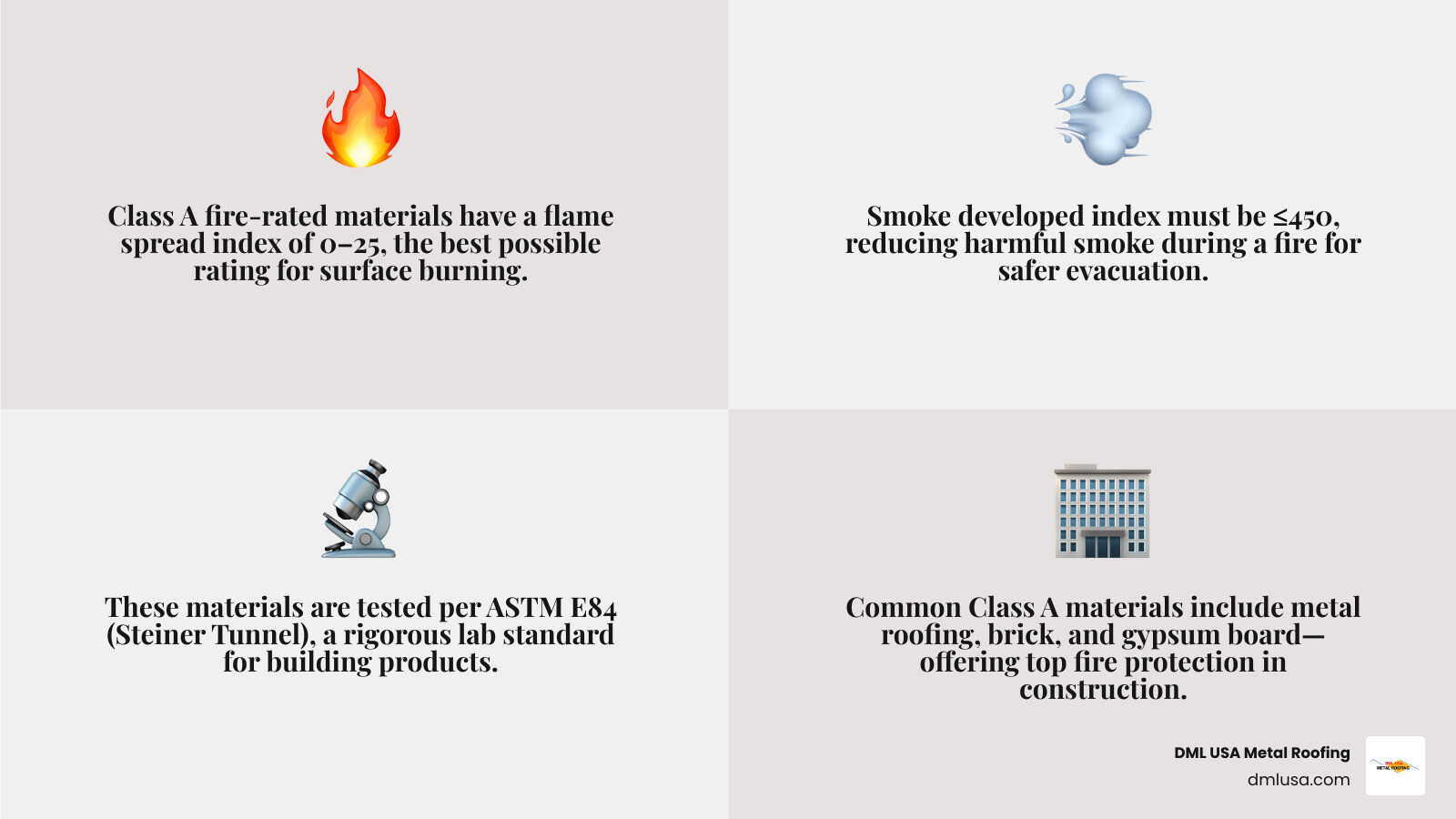
Class A fire-rated materials represent the highest standard of fire safety in construction, with a flame spread index of 0-25 and smoke development index of 0-450. These materials are tested under strict ASTM E84 standards and provide the best protection against fire spread and smoke generation.
Quick Reference: Class A Fire Rating Criteria
– Flame Spread Index: 0-25 (lowest possible rating)
– Smoke Development Index: 0-450 maximum
– Test Standard: ASTM E84 (Steiner Tunnel Test)
– Performance: Superior fire resistance and minimal smoke production
– Common Materials: Metal roofing, brick, gypsum board, fiber cement
Like water, fire can be both ally and enemy. U.S. fire departments respond to over 1.4 million fire calls annually, causing billions in property damage. In wildfire-prone areas and densely built neighborhoods, choosing the right fire-rated materials can mean the difference between a contained incident and devastating loss.
The confusion around fire ratings is real. Many homeowners lump terms like “fire-resistant,” “non-combustible,” and “Class A” together, but each has distinct meanings and performance levels. Understanding these differences helps you make informed decisions that protect your family and investment.
I’m Adam Kadziola, and through my years manufacturing metal roofing at DML USA, I’ve seen how Class A fire-rated materials like steel roofing panels provide superior protection compared to traditional options. My experience in home building and renovations has shown me that the right materials don’t just meet codes – they exceed expectations for safety and durability.
Class A fire-rated materials vocab explained:
– Class A roofing materials
– Eco-friendly roofing solutions
You’ll learn what Class A fire ratings really mean, how they’re tested, and why choosing the right materials is crucial for building safety. We’ll also cover the most popular Class A materials, how to upgrade existing buildings, and where codes require these top-performing products. Let’s get started!
What Does a Class A Fire Rating Mean?
Think of a Class A fire rating as the top honor roll for building materials when it comes to fire safety. When a product carries this label, it means it’s been put through tough lab tests to see how quickly flames travel across its surface and how much smoke it gives off if it burns.
The rules for a Class A fire-rated material are strict: the flame spread index must be between 0 and 25, and the smoke development index can’t go above 450. These numbers aren’t just picked out of a hat—they’re backed by years of fire research and real-life case studies.
To give you some perspective, testers use asbestos-cement board as the “zero” reference point in these tests (flame spread index of 0), while red oak lumber—a typical building wood—scores a hot 100. Most everyday wood materials fall between 90 and 160. So when you see a material rated as Class A, you know it beats standard wood by a mile when it comes to slowing down fire and limiting smoke.
Both the National Fire Protection Association (NFPA) 101 Life Safety Code and the International Building Code (IBC) Section 803 consider Class A the highest grade for surface burning characteristics. You’ll find Class A fire-rated materials required in places like building exits, high-rise corridors, and anywhere a fast-moving fire could put lives at risk. It’s also the standard referenced in major testing benchmarks like ASTM E84.
Now, it’s important to clear up a common myth: Class A doesn’t mean fireproof. No building material is truly fireproof. What it does mean is that the material is hard to ignite, and if it does burn, the fire crawls slowly and produces very little smoke. This is a huge deal for safety—it buys precious minutes for people to get out and for firefighters to arrive.
Why Class A Matters for Life Safety
So, why does a Class A fire rating matter so much? The reasons are all about giving folks the best shot at getting out safely:
First, Class A fire-rated materials slow down how quickly flames spread. Imagine a fire starting on a ceiling—if that ceiling is Class A, the flames take their sweet time moving, instead of racing across the room. This delay gives fire sprinklers (and firefighters) a fighting chance.
Second, these materials put out far less smoke. Most lives lost in fires aren’t because of flames, but because of smoke inhalation. Less smoke means you can see to find your way out and breathe easier as you make your escape.
And third, there’s a nice bonus for your wallet: many insurance companies offer lower premiums for buildings that use Class A fire-rated materials. We’ve seen folks save 10–20% on property insurance just by upgrading to Class A metal roofing. Insurance companies know from experience—these materials make a real difference in reducing fire losses.
In short, Class A fire ratings are about saving lives, protecting property, and giving you peace of mind. If you want to dive into the technical side, check out our info page on Class A roofing materials.
How Class A Ratings Are Determined: ASTM E84 & Other Tests
Ever wondered how building materials actually earn that coveted “Class A” fire rating? The main test is called ASTM E84, better known as the Steiner Tunnel Test. This test has set the standard for measuring how materials behave in a fire since the 1940s. The setup is pretty dramatic: imagine a long, 24-foot steel tunnel. Samples of the material are fixed to the ceiling. Then, two powerful gas burners blast flames across the surface, putting out about 89 kilowatts of heat—roughly what you’d get from a home furnace on overdrive.
While the flames do their thing for exactly 10 minutes, precise instruments track how far the fire spreads and how much smoke is produced. The conditions are tightly controlled—every sample is prepped at 73.4°F and 50% humidity. The tunnel itself is brought up to 150°F, then allowed to cool to about 105°F before each run. This ensures every test is fair and repeatable, no matter which lab is running it.
If you hear about UL 723 or NFPA 255, don’t worry—these are just equivalent tests to ASTM E84. In Canada, the CAN/ULC-S102.2 test uses a similar tunnel, with small differences in how materials are installed, but the results line up closely.
Roofing materials need a different kind of test, since they’re often exposed to burning embers during wildfires. That’s where ASTM E108 comes in. It simulates burning brands (imagine a flaming 12×12-inch block of wood) landing on roof assemblies to see if they’ll ignite. Only materials that can handle these fiery surprises earn the “Class A” stamp for roofs.
Key Metrics Explained
- Flame Spread Index (FSI): Tells us how quickly fire races across a material’s surface. Asbestos-cement board is the low bar, with a score of 0, and red oak wood is set at 100. To get a Class A fire rating, a material must score 25 or less—meaning it slows the fire to a crawl compared to wood.
- Smoke Developed Index (SDI): Measures how much smoke the material gives off as it burns. Photometers in the tunnel measure how much the smoke blocks out light. For a Class A fire-rated material, the smoke index must be 450 or lower—a high bar that many wood products can’t meet.
- Heat Release Rate (HRR): While not officially part of the Class A rating, it’s still an important number, especially in places like California. For example, deck boards can’t release more than 25 kilowatts per square foot. That’s a lot less than a burning bush (literally!), which can hit 1,000 kilowatts.
Beyond Surface Tests: Fire-Resistance Ratings
What about walls that are rated for “1 hour” or more? That’s a different kind of testing—ASTM E119. Instead of testing how fast fire spreads, this standard checks how long a whole wall or floor assembly can stand up to fire without collapsing. Here, an entire wall built with gypsum board and insulation is blasted by 1,700°F flames. A “1-hour” assembly needs to hold strong for at least an hour under these punishing conditions.
Scientific research on ASTM E119 shows that these ratings are best for comparing products—not for predicting exactly how long a real fire will last. After all, things like how much fuel is present, airflow, and how quickly firefighters arrive all play a role.
The takeaway? Class A fire-rated materials are tested for their ability to slow surface flames and minimize smoke, while fire-resistance ratings tell you how long an assembly can hold up structurally. Both are crucial, but they serve different purposes in keeping people and buildings safe. At DML USA Metal Roofing, we always recommend using the right material, with the right rating, in the right place—especially when safety is on the line.
Class A vs. Other Fire Ratings & Terms
Fire ratings can feel like alphabet soup, but the differences are simple once you see the numbers:
- Class A: Flame spread index 0–25. Best at slowing fire and smoke.
- Class B: 26–75. Slower than untreated wood but still allows flames to travel several times faster than Class A.
- Class C: 76–200. Common plywood, fiberboard, and similar products that ignite and spread fire quickly.
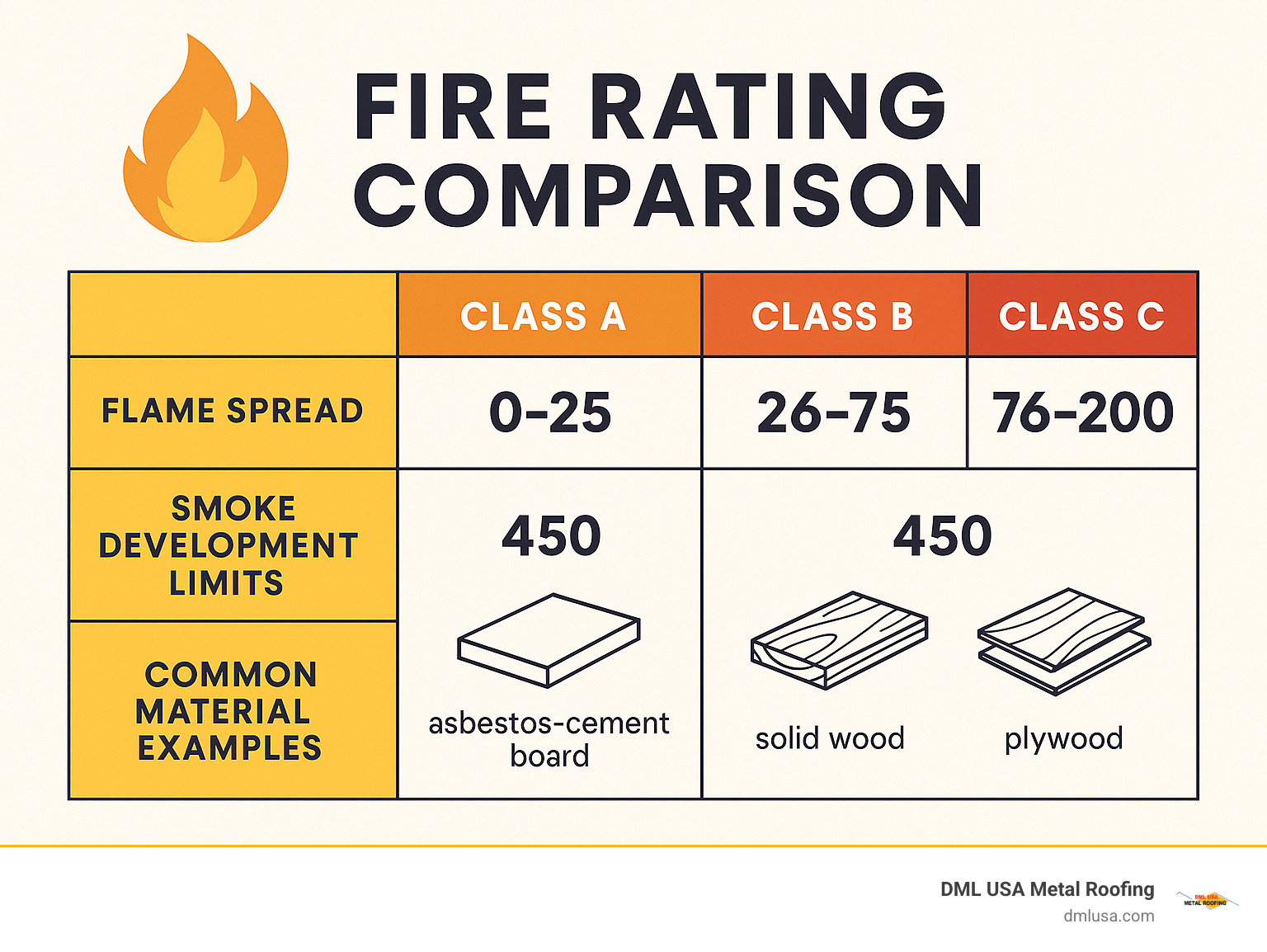
Why does the class matter? In a real fire, a Class A metal roof can localize flames long enough for sprinklers or firefighters to respond, while a Class C roof might allow a blaze to race across the entire surface in minutes.
Class A Fire-Rated Materials vs. Fire-Resistant Assemblies
Two rating systems often get mixed up:
- Surface ratings (Class A/B/C) test a single material for flame spread and smoke.
- Time-based fire-resistance ratings (e.g., “1-hour wall”) test complete assemblies for structural endurance under fire (ASTM E119).
Both are important: surface ratings keep materials from feeding a fire, and assembly ratings keep the structure standing so people can escape.
Non-Combustible & Ignition-Resistant
- Non-combustible (ASTM E136). Materials such as steel, brick, and concrete that will not burn under normal building-fire temperatures.
- Ignition-resistant (CBC 7A). Materials that still perform after accelerated weathering and a 30-minute flame test—critical in wildfire zones exposed to wind-blown embers.
Using Class A, non-combustible, or ignition-resistant products—especially on roofs, exterior walls, and egress paths—gives your building multiple layers of passive protection without ongoing maintenance.
Popular Class A Fire-Rated Materials and Assemblies
When it comes to protecting your home or building, choosing Class A fire-rated materials is one of the smartest moves you can make. At our Illinois manufacturing facility, we create metal roofing systems designed to meet and exceed Class A standards. Steel’s natural properties make it a champion for fire safety—but it’s not the only material that earns this top grade.
- Brick and masonry are classic examples of high-performing Class A materials. These products are virtually non-combustible, with flame spread indices close to zero, and they release very little smoke when exposed to fire. Similarly, concrete and stone are trusted choices for their sturdy, fire-stopping qualities.
- Gypsum wallboard is a real workhorse inside buildings. It’s packed with chemically bound water that gets released as cooling steam when heated—a clever little feature that helps slow down fire’s progress. That’s a major reason you’ll see gypsum board almost everywhere inside homes, schools, and offices.
- Fiber cement siding and panels combine the best of both worlds: durable cement and tough cellulose fibers. These panels are a top pick for resisting flying embers during wildfires, keeping your property safer when it matters most.
- Mineral wool insulation not only keeps your house warm in the winter and cool in the summer, but it also achieves Class A status. Unlike some other types of insulation, mineral wool can withstand very high temperatures and doesn’t give off dangerous fumes if exposed to flame.
Roofing Systems with Class A Fire-Rated Materials
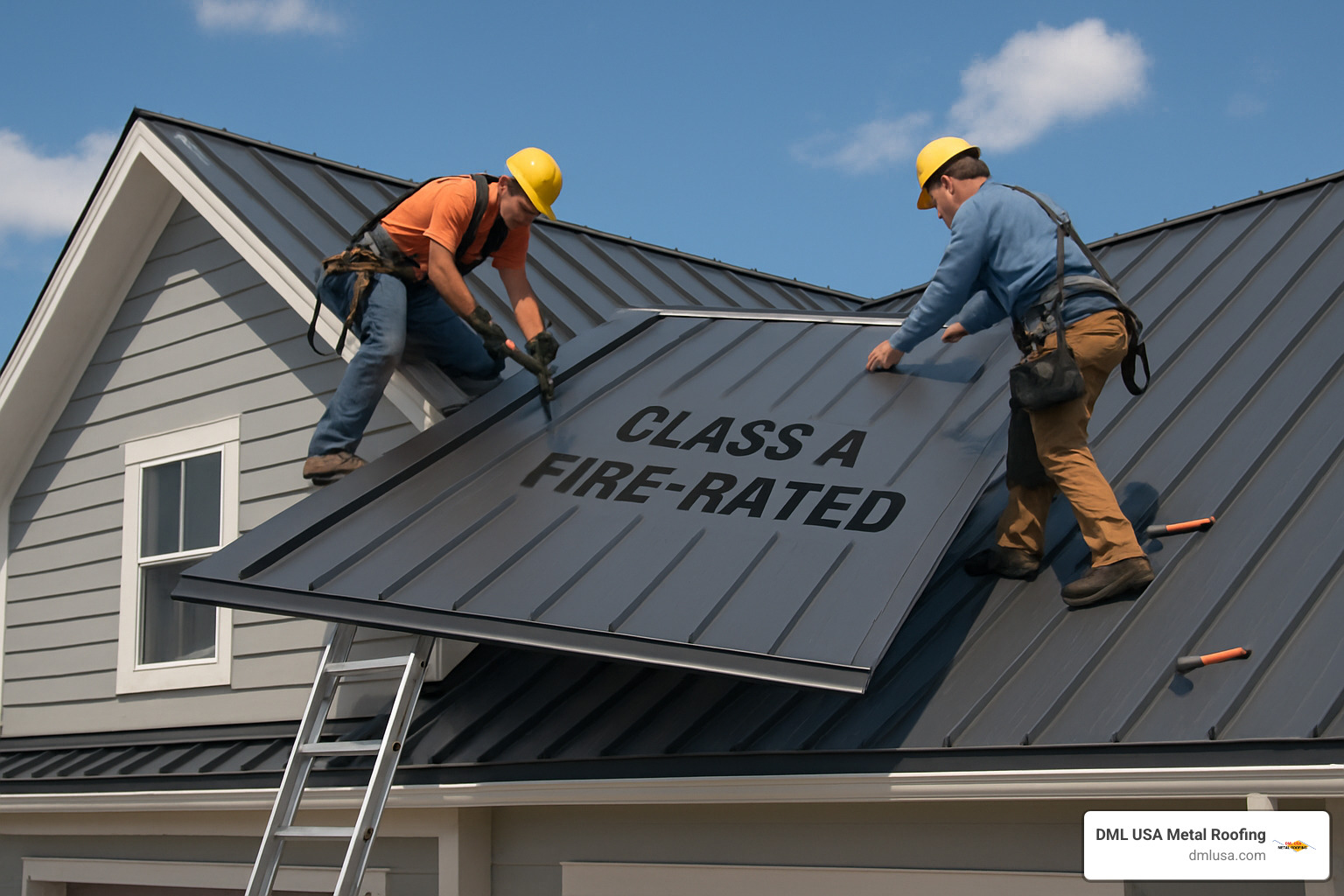
Metal roofing systems are well known for their Class A fire ratings, and for good reason. Both steel and aluminum panels are non-combustible, so they won’t catch fire from embers or direct flame. When these panels are paired with fire-resistant underlayment and installed with care, you get a roofing system that offers outstanding protection.
At DML USA, our steel panels not only hold up as individual Class A components, but also form complete Class A assemblies. The secret is using the right underlayment and making sure installation leaves no gaps for embers to sneak through.
To earn a UL 790 Class A rating, a roof system must pass tough tests: it has to stop burning brands from breaking through, prevent flames from spreading across the surface, and avoid dropping burning debris that could set something else on fire.
Want to know more about why metal roofing is such a solid option? Check out the benefits of metal roofing here. You’ll see that fire resistance is just the beginning—these roofs are also tough against wind, hail, and the elements.
Interior Finishes & Wall Systems
Inside the building, gypsum board is the MVP for Class A fire-rated walls and ceilings. Not only is it budget-friendly and easy to install, but it also does a fantastic job in fire tests, thanks again to its steam-releasing core.
Modular wall partitions and temporary wall systems can also reach Class A ratings if you pick the right materials and follow smart assembly methods. These systems are a life-saver in places like hospitals and schools, where every second counts during an emergency.
Don’t forget about ceiling panels—choosing Class A options here helps ensure your ceilings don’t add fuel to a fire. Major brands offer a wide selection of Class A panels that meet today’s building codes for interior spaces.
Coatings & Treatments That Achieve Class A
Sometimes, you want the warmth of wood or other combustible materials, but you still want top-notch fire safety. Enter intumescent paints and coatings—these products expand when heated, forming a thick, protective char that shields the underlying surface from fire.
Fire-retardant treated wood is another way to bring Class A performance to more traditional building styles. Special chemicals are pressure-treated into the wood, slashing flame spread and smoke production while keeping that natural wood look.
Just remember, the power of coatings and treatments depends on proper application and regular upkeep. Intumescent paints can protect for 30 to 120 minutes during a fire, but only if they’re applied at the right thickness and under the right conditions.
Looking for more options? The external guide to WUI products has a wealth of information on materials—many of them Class A rated—that are tested for use in wildfire-prone areas.
In the end, whether you choose steel panels, brick, gypsum, or advanced coatings, using Class A fire-rated materials is one of the best ways to safeguard your property and the people inside. If you have questions about which options fit your project, reach out—we’re here to help you build safer from the ground up.
Design & Retrofit Strategies for Safer Buildings
Choosing Class A fire-rated materials is only the start. A solid fire-safe design layers those materials with smart detailing and site planning.
In wildland-urban interface areas, Class A metal roofing and non-combustible siding act as an ember shield—critical because roughly 9 out of 10 home ignitions during wildfires start from wind-driven embers, not direct flames.
Passive protection (materials that simply resist burning) often outperforms active systems that need power, water, and maintenance. That’s why codes pair Class A surface ratings with time-rated assemblies in exits and load-bearing walls.
Upgrading Existing Buildings
- Over-cladding: Install metal or fiber-cement panels over existing combustible siding to add a Class A exterior without a full tear-off.
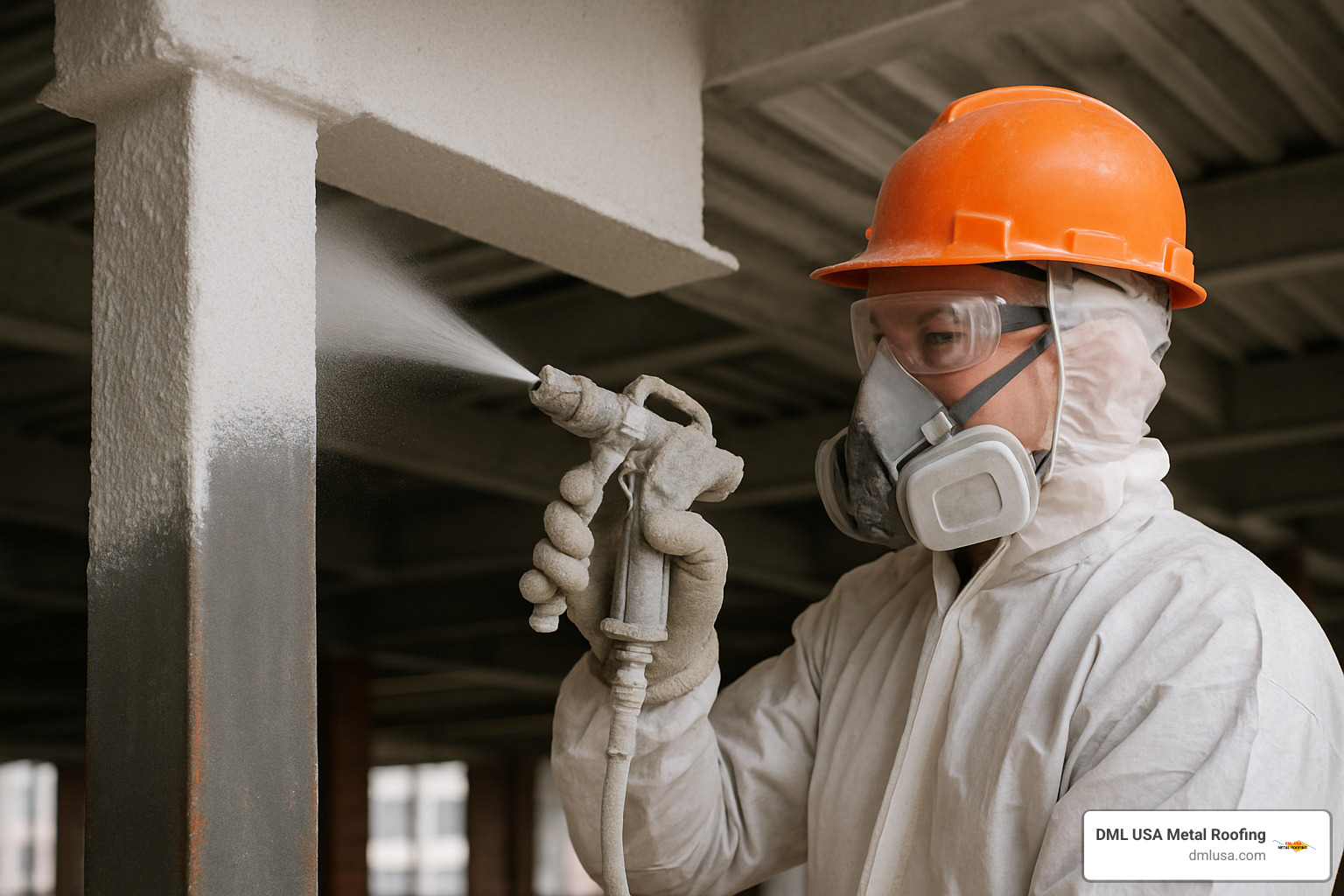
- Intumescent coatings: Spray-applied paints that swell into a char, upgrading exposed steel or wood to a Class A surface and adding up to 1-hour fire resistance.
- Insulation swaps: Replacing fiberglass batts with mineral wool improves both R-value and fire performance in one step.
When selecting retrofit products, look for ones that pass weathering requirements like California’s 12-week accelerated UV/moisture cycle—lab ratings alone are not enough outdoors.
Where Codes Demand Class A
- Exit corridors and stairwells in almost all commercial occupancies (IBC §803).
- Roof coverings in designated wildfire zones (CBC Chapter 7A and similar state rules).
- High-rise cores and shafts, where fire department ladders can’t reach upper floors.
For project-specific guidance, see our resources page or contact DML USA’s technical team.
Frequently Asked Questions about Class A Fire-Rated Materials
How long do Class A materials protect during a fire?
Class A measures surface flame spread (0–25) and smoke (≤450), not minutes of endurance. They slow ignition and limit smoke, buying valuable evacuation time, but true time ratings come from separate tests like ASTM E119.
Does Class A mean fireproof?
No material is fireproof. Class A means highly fire-resistant, not immune. Given enough heat and fuel, even Class A products will eventually fail, but they offer the best chance to contain a blaze early.
Are Class A materials mandatory everywhere?
They’re required in specific high-risk areas: exit paths, high-rises, and roofs in wildfire zones. Many owners still upgrade voluntarily because insurers often discount premiums for Class A roofs and exteriors. When in doubt, check local code or our resources page.
Conclusion
Knowing about Class A fire-rated materials puts the power of safety right in your hands. With their flame spread index of 0-25 and smoke development index of 450 or less, these materials set the bar for fire protection in construction. They slow down fires, limit smoke, and buy valuable time for people to get out safely—making a real difference when every second truly counts.
Here at DML USA Metal Roofing, we’ve witnessed how our Class A metal roofing systems protect homes and businesses under pressure. Our steel roofing panels don’t just pass the strictest fire tests—they’re also tough, maintenance-free, and come with the bonus of energy tax credits. That’s right: with Class A solutions, you’re not only shielding your property from fire, you’re also making it more energy efficient and environmentally friendly.
Investing in Class A fire-rated materials is a smart move for more than just peace of mind. Insurance companies respect these upgrades with lower premiums. Your property value can also get a boost thanks to improved safety features. It’s a single upgrade that delivers protection, savings, and long-term value all at once.
Whether you’re building something new or giving an older structure new life, choosing certified Class A solutions makes your building safer and more resilient. Code compliance, proven fire resistance, and extra benefits like energy credits all work together to protect what matters most.
If you’re ready to make your building safer and more sustainable, we’re here to help. Contact our team for project guidance and find how Class A metal roofing from DML USA can help safeguard your investment—while keeping energy costs and maintenance worries low.
Your safety, your savings, and your peace of mind can all start with one smart upgrade.
