 Skip to main content

Stone Coated Steel Shingles Cost: 7 Key Facts You’ll Love 2025
Why Stone-Coated Steel Shingles Are Worth the Investment
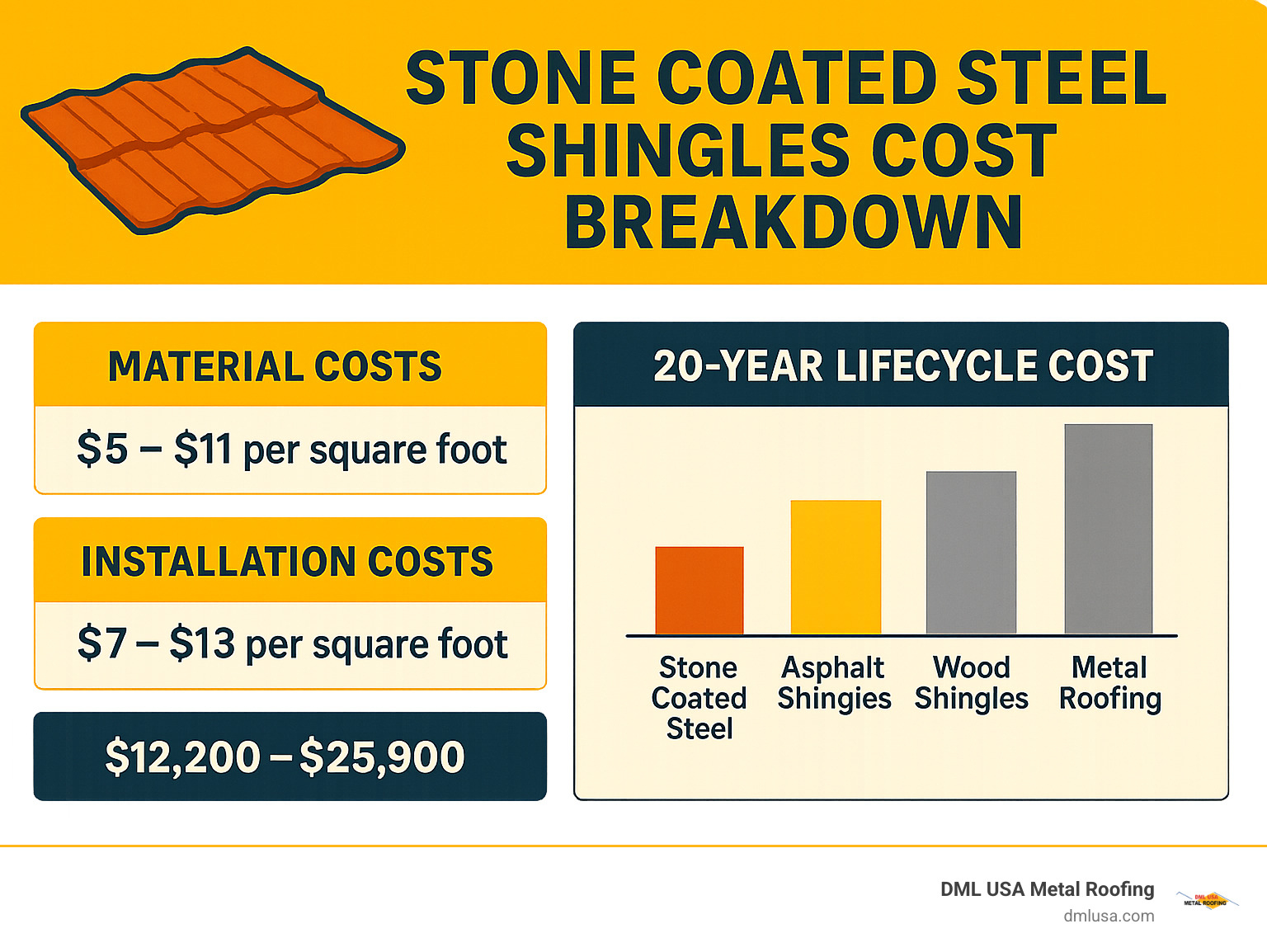
Stone coated steel shingles cost between $7 to $13 per square foot installed, making them a premium roofing choice that delivers exceptional long-term value. Here’s what you can expect to pay:
Quick Cost Overview:
– Materials only: $5-$11 per square foot
– Fully installed: $7-$13 per square foot
– Typical 1,700 sq ft home: $12,200-$25,900 total
– Average project cost: $19,500 nationwide
– Lifespan: 40-70 years (vs. 20 years for asphalt)
If you’re tired of dealing with frequent roof repairs and the endless cycle of asphalt shingle replacements, you’re not alone. Many homeowners are finding that stone-coated steel shingles offer the perfect blend of durability, aesthetics, and long-term savings – even though they require a higher upfront investment.
These innovative roofing systems combine the strength of steel with the natural beauty of stone granules, creating a roof that can withstand extreme weather while maintaining its curb appeal for decades. Unlike traditional asphalt shingles that need replacement every 15-20 years, stone-coated steel roofs can last up to 70 years with minimal maintenance.
The key question isn’t whether stone-coated steel costs more initially – it’s whether the long-term value justifies the investment. When you factor in energy savings, reduced maintenance, increased home value, and the elimination of future roof replacements, many homeowners find these roofs actually save money over time.
I’m Adam Kadziola, and through my experience manufacturing metal roofing products at DML USA Metal Roofing since 2007, I’ve helped countless homeowners understand the true stone coated steel shingles cost and long-term value proposition. Let me walk you through everything you need to know to make an informed decision about this premium roofing investment.
Stone-Coated Steel Shingles 101
Stone-coated steel shingles combine old-world beauty with modern technology. At their core is a solid steel base covered with protective layers and topped with real stone granules for that classic look.
The steel core gives shingles their strength, handling wind gusts up to 120 mph. The natural stone chips shield your roof from UV rays, help with sound dampening (no tin-roof “pinging” during storms), and deliver texture and color that mimic classic wood shake, tile, or asphalt. It’s like having your cake and eating it too—all the curb appeal, with none of the fuss.
The design uses interlocking panels that snap tightly into place. Water, wind, and hail have a tough time sneaking in. Traditional shingles overlap, which can leave gaps for leaks. Stone-coated panels lock together to form a tight, continuous barrier. Most panels are about 1 foot by 3 feet, making them easy for installers to handle while covering sections quickly and securely.
Style-wise, you’ve got options galore. Want Mediterranean clay tile vibes? How about rustic wood shake or classic shingle? Stone-coated steel can do it all, with a wide range of colors and textures to match your taste—or your HOA’s demands.
One huge plus is weight. Clay tiles can weigh 600-900 pounds per square (100 square feet), but stone-coated steel shingles weigh just 140-180 pounds per square. That’s a big relief for your roof’s structure—and often means you won’t need costly reinforcements before installation.
Safety is another highlight. Stone-coated steel shingles are typically rated Class A for fire resistance—the highest you can get. They also pass tough impact tests (Class 4 under UL 2218) for hail.
And when your roof finally retires after decades of service, it won’t end up in a landfill. Stone-coated steel shingles are 100% recyclable, and many are made with recycled steel. Pair that with excellent energy efficiency—thanks to reflective coatings and air gaps that help keep your home cooler in summer—and you’ve got a roof that’s easy on both your wallet and the planet.
How They’re Made
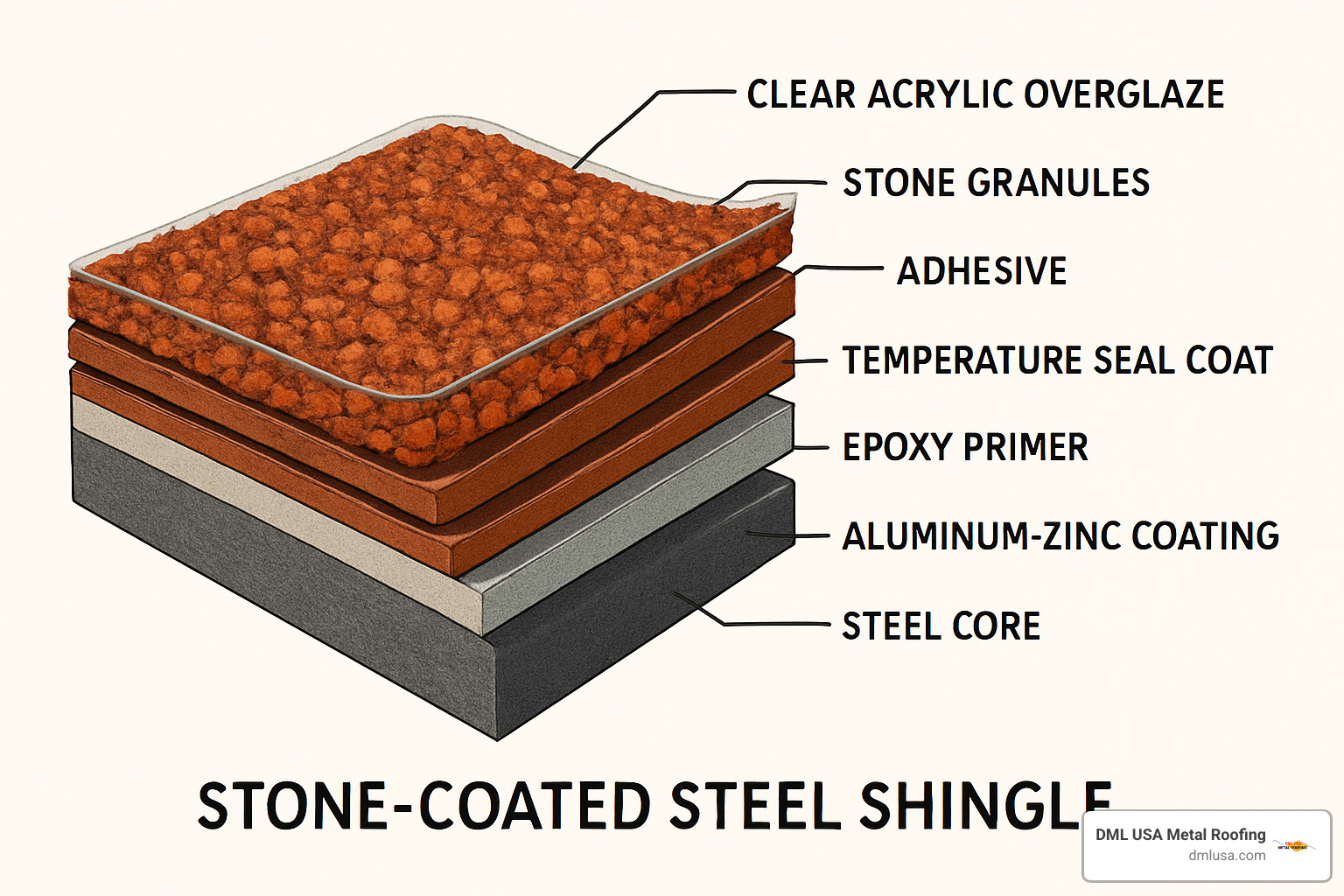
Stone-coated steel shingles are built up in seven layers, each with a special job.
It starts with 26 or 28 gauge galvanized steel, giving the panel its strength. On top is an aluminum-zinc alloy coating that fights off rust and corrosion. Next, an epoxy primer makes sure everything sticks together properly. There’s a temperature seal coat to help the metal expand and contract through seasons without cracking.
After that comes the acrylic base, where stone granules are pressed into the wet acrylic, locking them in place. Finally, a clear acrylic over-glaze seals everything, adding UV protection and keeping the stones where they belong.
This process is precisely controlled. The result? Panels that meet the highest standards—Class 4 impact resistance and wind protection up to 120 mph.
Key Advantages vs Traditional Shingles
Why switch from regular asphalt shingles to stone-coated steel? The difference is night and day.
Longevity is huge: where asphalt lasts just 15-25 years, stone-coated steel keeps going strong for 40-70 years. Maintenance is a breeze; instead of dealing with curling, cracking, or bald spots, a quick cleaning and check-up now and then will do.
Energy efficiency is another win—you’ll notice lower cooling bills, as the reflective stone coatings help bounce heat away from your home, unlike dark asphalt that soaks it up.
Looks and curb appeal? Stone-coated steel delivers real depth and dimension, with colors that stay true for decades—no fading, no granules clogging your gutters.
Resale value is strong, too. Studies show premium roofs like these can boost your home’s value, with an ROI of 55-80%—much better than basic shingle jobs.
If you want to dive deeper into the benefits, check out Why Choose Metal Roofing for more insights.
With stone-coated steel shingles, you get peace of mind, long-lasting beauty, and a roof that pulls its weight—without weighing you down on maintenance or replacement costs.
Stone Coated Steel Shingles Cost: National Averages & Breakdown
Let’s get down to brass tacks: how much do stone coated steel shingles cost? Here’s what you can expect, whether you’re budgeting for a cozy ranch or something grander.
Materials alone cost about $450 to $650 per roofing square (100 square feet), which works out to $4.50-$6.50 per square foot just for the shingles. The “extras”—like underlayment, fasteners, flashing, and finishing touches—typically add another $50-$150 per square. These parts might not be flashy, but they’re essential for a roof that’s both beautiful and built to last.
Labor varies more by location. Depending on where you live and how complex your roof is, installation costs usually range from $550 to $1,000 per square. Steep slopes, lots of angles, or features like dormers can push labor costs higher. Altogether, a full install usually lands between $7 and $13 per square foot. Most homeowners find themselves right around the $10 per square foot mark.
Across the U.S., the average total cost for a new stone-coated steel roof hovers around $19,500. Smaller homes see totals as low as $13,000, while larger or more intricate homes can go up to $85,000.
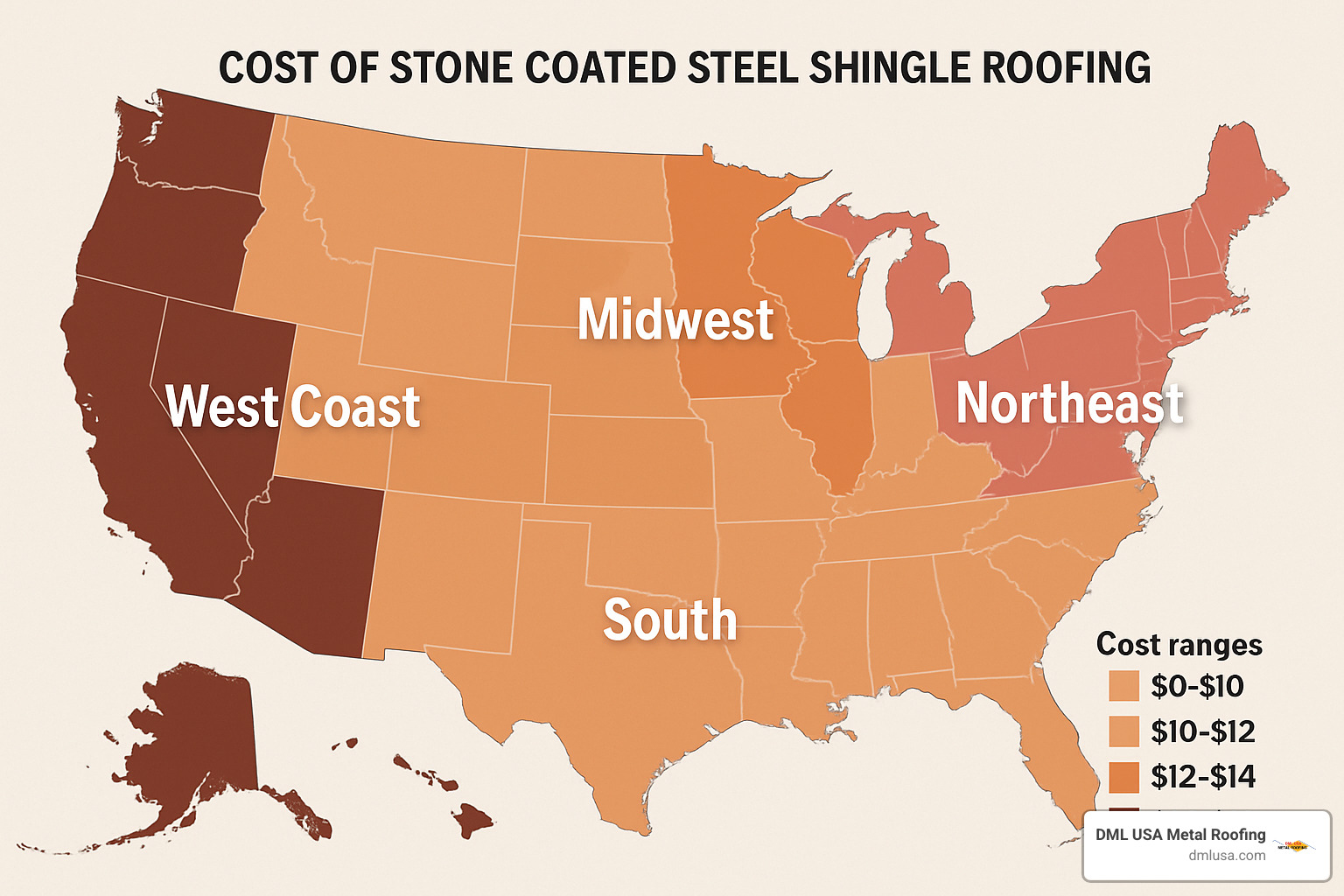
Where you live matters, too. High-cost cities might see prices 20-40% higher than the national average. Meanwhile, folks in the Midwest or Southern states might see prices 10-20% lower.
Stone Coated Steel Shingles Cost Per Square Foot
Materials typically run $5-$11 per square foot. Basic shingle profiles cost less, while premium shake or tile looks with more texture fall at the higher end. Don’t forget about underlayment and accessories, which add another $0.50-$1.50 per square foot.
Labor usually lands from $3-$8 per square foot. Simple roofs with gentle slopes are easier (and cheaper), while complicated or steep roofs cost more, sometimes $6-$8 per square foot just for installation. If your old roof needs to come off first, add another $1-$3 per square foot for tear-off.
Location is a big factor. Roofers in major cities can charge more for their expertise, while rural areas may have lower labor rates—but material costs sometimes climb due to extra shipping.
Underlayment choice matters as well. Basic felt is cheaper, but many installers (and warranties) require high-quality synthetic underlayment. It costs more, but pays off with better moisture protection and a longer-lasting roof.
Total Project Price for a Typical Home
For a typical American home with about 1,700 square feet of roof, you’ll probably spend somewhere between $12,200 and $25,900 for a full installation. A smaller home (1,200 sq ft) might cost $8,400 to $15,600, while a larger house with 2,500 square feet of roofing could see totals from $17,500 to $32,500. Especially large homes with lots of roof angles could cost $24,500 to $45,500+.
Beyond shingles and labor, other items are important for your budget. Permits can be anywhere from $400 to $2,700. Disposal of old roofing might run $300-$800 per square removed. If the underlying structure needs fixes, set aside $500-$3,000 for repairs. Roof upgrades like ventilation improvements usually cost $300-$1,200, and gutter replacement could add $1,000-$3,000 if needed.
At first glance, the stone coated steel shingles cost can seem high—but remember, this is likely the last roof you’ll ever put on your home. When you factor in the savings from not having to replace your roof every 15-20 years, plus energy efficiency and curb appeal, the long-term value looks much brighter.
Ready to dig deeper? In the next sections, we’ll explore what drives these prices and how costs stack up to other roofing options. If you want to learn more about the benefits of metal roofing, check out Why Choose Metal Roofing or browse our full line of products at DML USA Metal Roofing.
Price Drivers & Comparisons With Other Roofs
Several key factors influence your final stone coated steel shingles cost. Understanding these price drivers helps you budget accurately and make informed decisions.
Roof pitch and complexity have the biggest impact on installation costs. If your roof has a steep pitch (8:12 or steeper), expect labor costs to increase by 25-50%. Those beautiful dormers, multiple roof levels, and architectural features make installation more challenging and time-consuming.
Your geographic location affects pricing significantly. Coastal homes often need improved corrosion protection, while areas prone to severe weather require upgraded fastening systems. Distance from manufacturing facilities also impacts material transportation costs.
Brand and grade selection creates meaningful price differences. Premium manufacturers typically charge 15-30% more than basic options, but they often back their products with longer warranties and superior performance track records.
The finish type you choose matters for both cost and longevity. PVDF finishes cost more upfront than SMP finishes but provide better fade resistance and longer warranties. For stone-coated systems, the quality of the stone coating process varies considerably among manufacturers.
Installation method presents another decision point. Batten systems that create an air gap between the roof deck and shingles cost more but offer superior ventilation and performance. Direct-to-deck installation is quicker and less expensive while still delivering excellent results.
| Roofing Material | Cost per Sq Ft | Lifespan | 50-Year Cost |
|---|---|---|---|
| Asphalt Shingles | $3-7 | 20 years | $15,000-35,000 |
| Stone-Coated Steel | $7-13 | 50+ years | $7,000-13,000 |
| Standing Seam Metal | $8-16 | 50+ years | $8,000-16,000 |
| Clay Tile | $8-25 | 50+ years | $8,000-25,000 |
| Natural Slate | $10-25 | 75+ years | $10,000-25,000 |
How Stone-Coated Pricing Compares
While stone coated steel shingles cost more upfront than basic asphalt shingles, the long-term financial picture tells a different story.
Asphalt shingles might seem like a bargain at $3-7 per square foot installed, but they need replacement every 15-25 years. Over 50 years, you’re looking at 2-3 complete roof replacements. That “affordable” option suddenly costs $15,000-35,000 for an average home when you factor in multiple replacements.
Standing seam metal costs $8-16 per square foot and offers similar longevity to stone-coated systems. However, many homeowners prefer the traditional appearance that stone-coated shingles provide.
Clay tile delivers comparable longevity but costs $8-25 per square foot and weighs significantly more than stone-coated steel. Many homes need structural reinforcement to handle the extra weight.
Natural slate represents the premium end at $10-25 per square foot. While beautiful and incredibly long-lasting, it demands specialized installation skills that are rare and costly. Plus, not every home can support slate’s substantial weight.
Stone-coated steel shingles occupy that sweet spot in the market. You get the longevity of premium materials with the aesthetic appeal of traditional shingles at a moderate price point. With a 40-70 year lifespan, most homeowners will never need another roof replacement.
Additional Costs to Expect
Beyond the basic stone coated steel shingles cost, several other expenses deserve consideration.
Old roof removal typically adds $1-3 per square foot to your project cost. While some stone-coated systems can be installed over existing shingles, most manufacturers recommend complete tear-off for optimal performance and full warranty coverage.
Structural repairs sometimes surprise homeowners, especially those with older homes. Common issues include replacing damaged decking at $2-5 per square foot, reinforcing rafters for $500-2,000, or upgrading ventilation systems for $300-1,200.
Ventilation upgrades often become necessary to meet current building codes and manufacturer warranty requirements. Proper ventilation extends your roof’s life and improves energy efficiency.
Snow guards make sense in areas with significant snowfall, preventing dangerous snow slides. These safety features typically cost $3-8 per linear foot installed.
Insurance considerations vary by company and location. Some insurers offer discounts for impact-resistant roofing, while others may have specific installation requirements.
Installation, Lifespan, Maintenance, ROI & Warranties
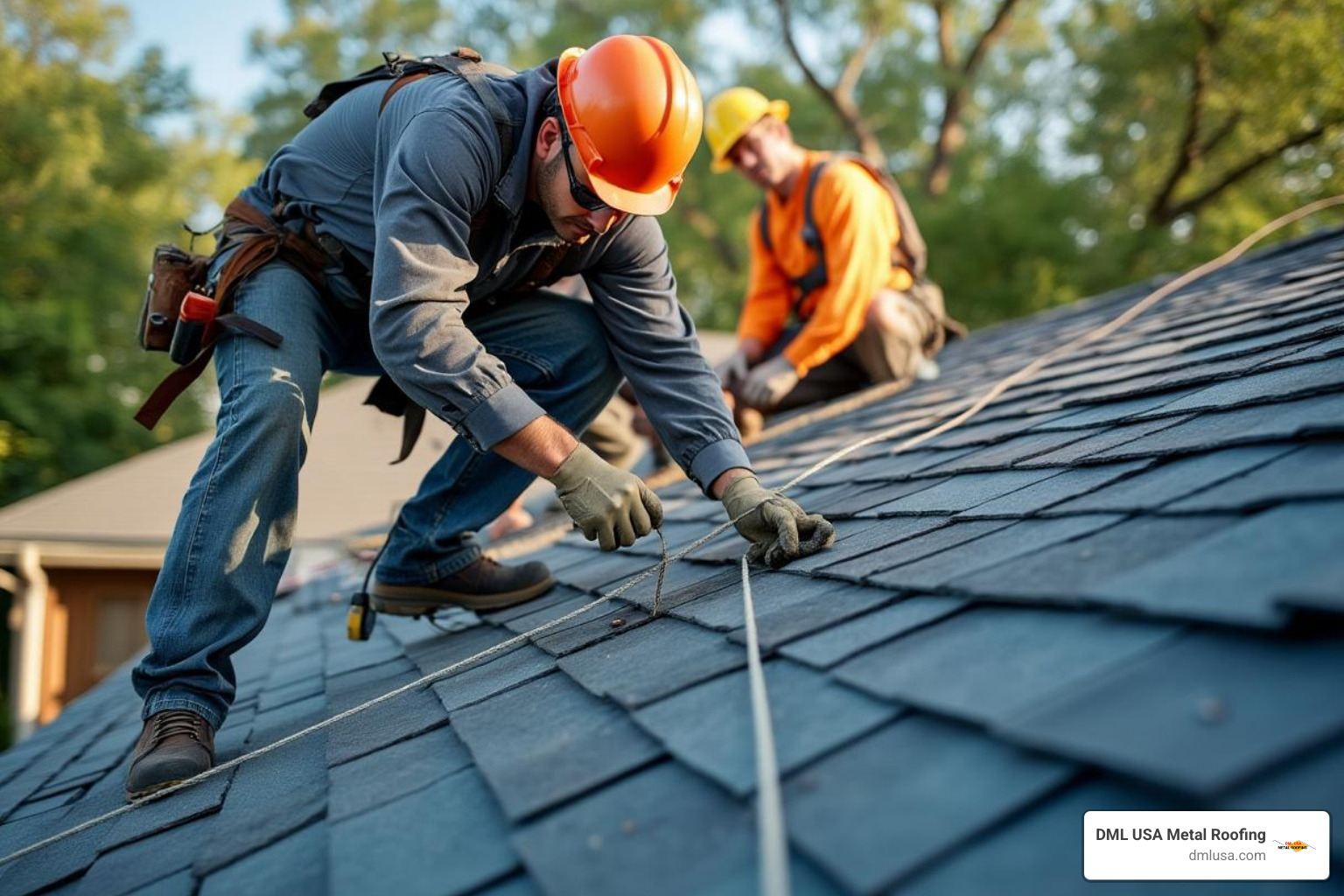
Proper installation is crucial for maximizing the performance and lifespan of stone-coated steel shingles. The process typically takes 2-5 days for an average home, depending on size and complexity.
Installation begins with removing the old roofing (if required) and inspecting the deck for damage. New underlayment is installed, followed by starter strips and the interlocking shingle panels. Each panel must be properly aligned and fastened according to manufacturer specifications.
The impressive 40-70 year lifespan of stone-coated steel shingles is one of their primary value propositions. This longevity is achieved through multi-layer construction and superior materials that resist common failure modes of traditional shingles.
Maintenance requirements are minimal but important:
– Annual inspections for loose fasteners or damaged panels
– Cleaning gutters and removing debris from roof valleys
– Occasional washing to maintain appearance (every 3-5 years)
– Checking and maintaining proper ventilation
– Inspecting flashing around penetrations
Return on investment for stone-coated steel roofing typically ranges from 55-80% when selling a home. This compares favorably to basic asphalt shingle replacements that typically return 60-65%. The premium appearance and known longevity appeal to potential buyers.
Energy savings can be substantial, particularly in hot climates. The reflective properties of the stone coating can reduce cooling costs by 10-25% compared to dark asphalt shingles. Some homeowners may qualify for energy efficiency tax credits.
Manufacturer warranties typically range from 30-50 years, with some offering limited lifetime warranties. These usually cover material defects and may include prorated coverage for wind and hail damage. Labor warranties from certified installers typically range from 2-10 years.
Finding a Qualified Installer
Selecting the right contractor is crucial for a successful installation. Look for roofers who are:
- Licensed and insured in your state and locality
- Certified by manufacturers for the specific products you’re considering
- Members of professional organizations like the National Roofing Contractors Association
- Experienced with metal roofing systems specifically
Questions to ask potential contractors:
– How many stone-coated steel roofs have you installed?
– Are you certified by the manufacturer?
– Can you provide local references from recent projects?
– What warranty do you provide on workmanship?
– How do you handle permits and inspections?
Get at least three detailed written estimates that specify materials, labor, timeline, and warranty terms. Be wary of door-to-door salespeople or contractors demanding large upfront payments.
Resources provides additional guidance on selecting qualified roofing professionals.
Money-Saving Tips & Financing
Several strategies can help reduce stone coated steel shingles cost:
Off-season installation (late fall through early spring in most areas) often results in 10-20% savings as contractors offer discounts during slower periods. However, weather delays are more likely.
Bundle projects like roofing with siding, gutters, or windows to negotiate better overall pricing with contractors.
Permit preparation – handling permits yourself can save $200-500, though many contractors prefer to manage this process.
Financing options are widely available:
– Home improvement loans with fixed rates
– Home equity lines of credit (HELOC) for lower interest rates
– Manufacturer financing programs (often 0% for qualified buyers)
– FHA 203(k) loans for major renovations
Local rebates may be available for energy-efficient roofing. Check with your utility company and local government for current programs.
DIY caution: While some homeowners consider self-installation to save money, we strongly discourage this approach. Stone-coated steel shingle installation requires specialized knowledge, tools, and safety equipment. Improper installation will void warranties and could result in serious injury.
Can Stone-Coated Roofs Be Installed Over Existing Shingles?
Many stone-coated steel systems can be installed over existing asphalt shingles, potentially saving $1-3 per square foot in tear-off and disposal costs. However, several factors must be considered:
Weight limits: Most structures can support one layer of existing shingles plus the new stone-coated system, but engineering evaluation may be required for older homes.
Warranty impact: Some manufacturers require complete tear-off for full warranty coverage. Installing over existing shingles may result in reduced warranty terms.
Performance considerations: Installing over existing shingles can trap moisture and reduce ventilation effectiveness. Complete tear-off allows inspection and repair of the deck.
Code compliance: Local building codes may prohibit installation over existing roofing or limit the number of layers allowed.
While overlay installation can save money upfront, complete tear-off is generally recommended for optimal performance and warranty coverage.
Frequently Asked Questions about Stone Coated Steel Shingles Cost
Does the upfront price really pay off long term?
The answer is a resounding yes, and the numbers tell a compelling story. While stone coated steel shingles cost more upfront than traditional asphalt shingles, they’re actually one of the smartest financial decisions you can make for your home.
Let me break down the real math. Say you’re looking at a typical home where asphalt shingles would cost $8,000 to install. Those shingles will need replacement every 20 years, so over 60 years, you’re looking at three complete roof replacements. Factor in inflation, and you could easily spend $30,000 or more.
Compare that to stone-coated steel at $15,000 upfront. That’s it – one payment for the next 60+ years. The breakeven point typically hits around year 15-20, and after that, it’s pure savings.
But here’s where it gets even better. Your energy bills will be lower thanks to the reflective properties of the stone coating. You’ll spend less on maintenance and repairs. Plus, your home’s value increases significantly – we’re talking about a 55-80% return on investment if you sell.
The longevity factor alone makes the investment worthwhile. Think about it – this could be the last roof you ever buy. No more dealing with contractors every two decades, no more surprise repair bills, no more worrying about storm damage.
Are stone-coated steel roofs noisy during rain or hail?
This question always makes me smile because it’s based on a myth that just won’t die. The truth is, stone-coated steel shingles are actually quieter than traditional asphalt shingles during storms.
The stone coating acts like a natural sound dampener, absorbing and deflecting noise rather than amplifying it. When you combine this with proper attic insulation (which most homes already have), the sound transmission is minimal.
I’ve had countless customers tell me they were amazed at how quiet their new roof is during rainstorms. Some even say they miss the gentle patter of rain they used to hear with their old asphalt shingles.
The key difference is in the installation method. Stone-coated steel shingles are installed directly over solid decking with proper underlayment, creating multiple layers that absorb sound.
During hail storms, the stone coating actually cushions the impact, reducing both noise and potential damage. It’s one of those pleasant surprises that comes with choosing a premium roofing system.
Is this a DIY-friendly project?
I understand the temptation to tackle this project yourself, especially when you’re looking at the stone coated steel shingles cost and thinking about saving on labor. But I need to be completely honest with you – this is not a DIY project.
Safety is my biggest concern. Roofing work is dangerous, and professional roofers have years of training, proper safety equipment, and insurance protection. Every year, we hear about serious injuries from homeowners attempting roof work. It’s simply not worth the risk.
Then there’s the warranty issue. Most manufacturers require professional installation by certified contractors. Attempt a DIY installation, and you’ll void your warranty completely. That means if something goes wrong, you’re on your own for potentially thousands of dollars in repairs.
The technical aspects are more complex than they appear. Proper installation requires understanding building codes, flashing details, ventilation requirements, and manufacturer specifications. Small mistakes can lead to major problems – leaks, wind damage, or premature failure.
When you factor in the cost of tools, materials, your time, and the risk involved, professional installation often provides better value. The labor portion of your investment includes expertise, insurance, warranties, and peace of mind that you simply can’t get from a DIY approach.
Trust me, this is one project where calling the professionals is the smart move.
Conclusion
Choosing a new roof is a big decision, and it’s natural to focus on price. Yes, stone coated steel shingles cost more up front than basic asphalt shingles. But if you look beyond the initial bill, the real story is about value—how much more you get back for what you spend.
These roofs are built to last 40 to 70 years, which is 2-3 times longer than most asphalt options. That means you could very well be installing the last roof your home will ever need! Over the years, you’ll spend less time worrying about repairs and replacements, and more time just enjoying the peace of mind that comes from knowing your roof can handle pretty much anything—wind, hail, fire, even the blazing summer sun.
Energy efficiency is another gift that keeps on giving. Many homeowners see savings of 10-25% on cooling costs, thanks to the reflective stone coating and smart panel design. And let’s not forget curb appeal: stone-coated steel can mimic the look of shake, tile, or traditional shingles, holding its color and beauty for decades.
When you add up all the benefits—longevity, durability, energy savings, low maintenance, and a 55-80% return on investment when you sell your home—the initial stone coated steel shingles cost starts to look like a smart, long-term investment. In fact, over a typical roof’s lifetime, stone-coated steel often ends up costing less than replacing cheaper alternatives again and again.
Here at DML USA Metal Roofing, we’ve been manufacturing reliable, maintenance-free metal roofing products in Illinois since 2007. Our stone-coated steel systems are designed for maximum protection and beauty, with tough resistance to wind, fire, and impact. We take pride in our work, and we back it up with strong warranties and friendly, helpful service.
Ready to see how stone-coated steel can transform your home and protect your investment for decades to come? Let us help you find the perfect fit for your style and budget. Reach out to our team today—you might even enjoy talking about roofing (we sure do!).
Products – Take a look at our full line of stone-coated steel roofing systems and start your journey to a beautiful, worry-free roof.
