 Skip to main content

Roofing Tax Credit: 10 Powerful Eligibility Facts for 2025
Why Understanding Roofing Tax Credits Can Save You Thousands
A roofing tax credit can reduce your tax bill dollar-for-dollar when you install qualifying energy-efficient roofing materials. Here’s what you need to know:
Current Federal Roofing Tax Credits (2024-2025):
- Energy Efficient Home Improvement Credit: 30% of material costs, up to $1,200 annually
- Residential Clean Energy Credit: 30% of solar roofing costs, no upper limit
- Qualifying materials: ENERGY STAR metal roofs, cool asphalt shingles, solar shingles
- Important: Only materials qualify – labor and installation costs don’t count
- Eligibility: Primary residence only, existing homes
The federal government extended these credits through 2032 as part of the Inflation Reduction Act. This gives you time to plan your roof upgrade.
Tax credits are different from deductions. A $1,000 credit cuts your tax bill by exactly $1,000. A $1,000 deduction only saves you $220 if you’re in the 22% tax bracket.
Many homeowners don’t realize that energy-efficient metal roofing can qualify for these substantial savings. The key is choosing materials that meet specific performance standards and keeping proper documentation.
I’m Adam Kadziola, and I’ve been helping homeowners steer roofing tax credit opportunities since founding DML USA Metal Roofing in 2007. Through years of working with customers on energy-efficient metal roof installations, I’ve seen how these credits can make premium roofing materials much more affordable.
Glossary for roofing tax credit:
- energy star shingles tax credit
- new roof with solar panels tax credit
- solar tax credit roof replacement
How Roofing Tax Credits Work
The federal government wants to help you save money while making your home more energy-efficient. It does this with dollar-for-dollar tax credits instead of small deductions.
- Energy Efficient Home Improvement Credit – 30 % of qualifying roofing material costs, up to $1,200 per year through 2032.
- Residential Clean Energy Credit – 30 % of the entire cost of a solar roofing system (materials and labor) with no cap and carry-forward of unused amounts.
- Section 179 (business only) – lets companies deduct up to $1.16 million for commercial roof improvements in the year work is completed.
All three are non-refundable: they can drop your tax bill to zero but will not create a larger refund.
| Credit | Rate | Annual Cap | Carry-forward | Applies To |
|---|---|---|---|---|
| Energy Efficient Home | 30 % | $1,200 | No | Materials only |
| Residential Clean Energy | 30 % | None | Yes | Full solar system |
| Section 179 (commercial) | 100 % | $1.16 M | No | Full roof cost |
Tax Credit vs. Tax Deduction
A $1,000 credit lowers your IRS bill by $1,000. A $1,000 deduction saves only $220 if you are in the 22 % bracket. Standard roof replacements also raise your home2s cost basis, reducing future capital-gains tax2but that benefit is long-term, not immediate.
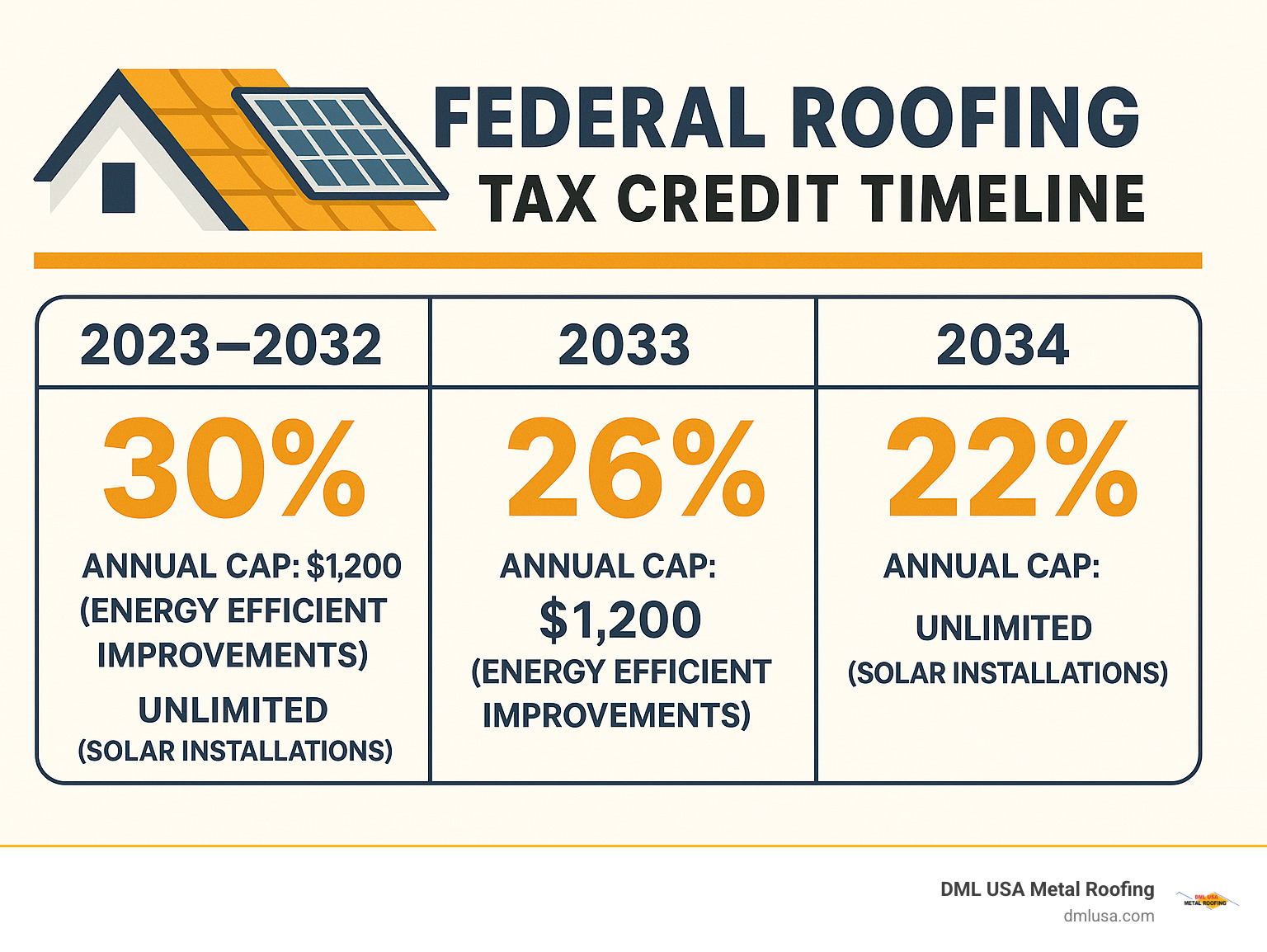
Credit Rates Through 2034
The 30 % rate is locked in from 2023-2032. It drops to 26 % in 2033 and 22 % in 2034. On a $10,000 qualifying project, waiting until 2034 costs you $800 in lost federal incentives alone. Planning now secures the maximum savings.
Who and What Qualifies for a Roofing Tax Credit
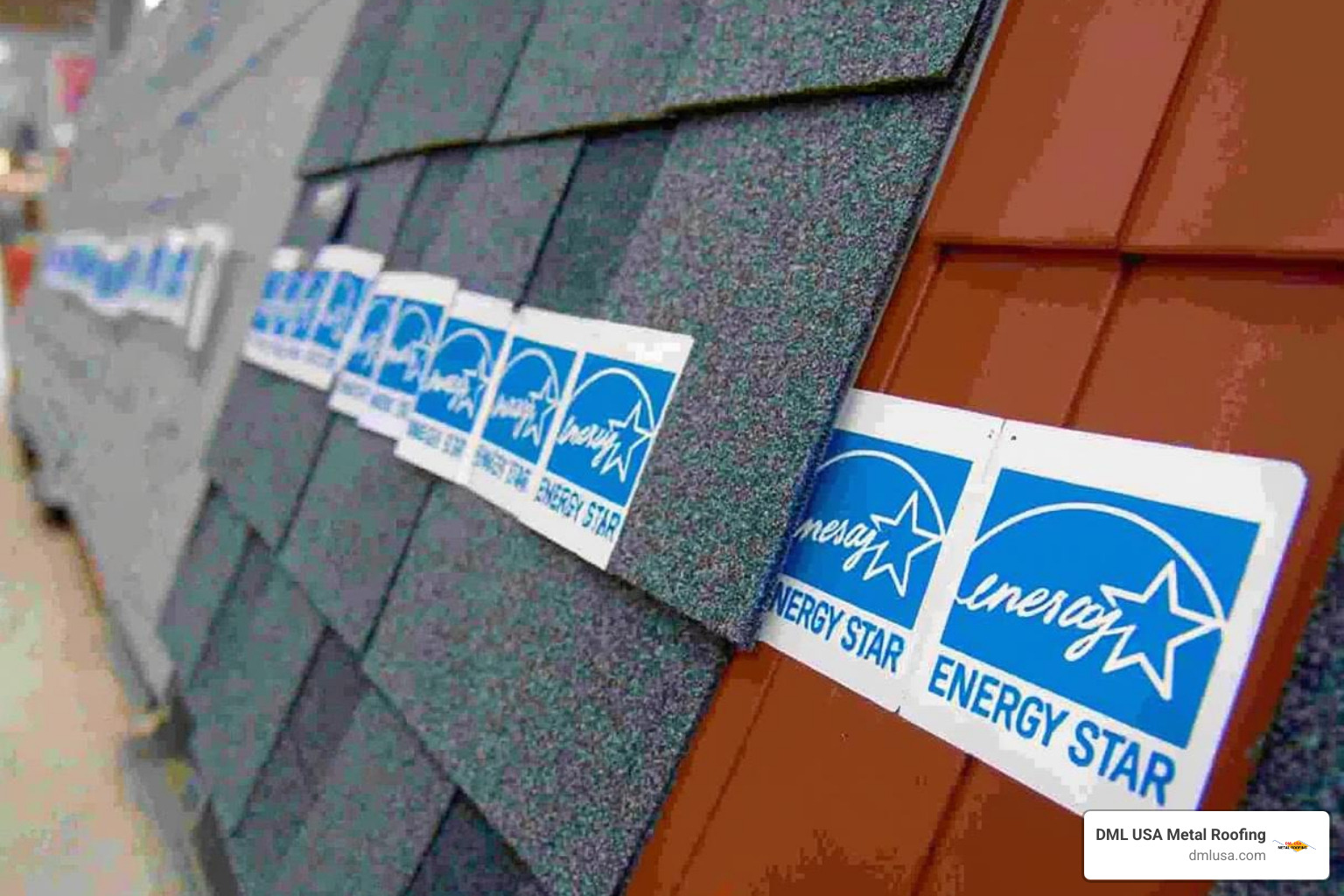
Wondering if your new roof will help you save with a roofing tax credit? The answer depends on a few key details—where you live, what kind of home you have, and what materials you choose.
First, your property needs to be your primary residence—the place you call home most of the year. Your project must be for an existing home (not new construction) located in the United States. If you’re a landlord or working on a rental, the rules are different, and most roofing tax credit programs for homeowners won’t apply. Owners who both live in and run a business from their home, though, can sometimes claim a portion of the improvements—more on that below.
The real heart of the matter is the roofing material. To qualify, you’ll need to use ENERGY STAR certified metal roofing with a special reflective coating or cool asphalt shingles with heat-deflecting granules. For a bigger leap into efficiency, solar shingles and solar roofing tiles that generate electricity also qualify—these even allow you to claim both material and installation costs under the Residential Clean Energy Credit. Whichever route you go, the material needs to have a useful life of at least five years to be eligible.
Here’s a quick tip: only the cost of materials counts for most residential credits—not the labor. This means if you spend $7,000 on metal panels and $3,000 on installation, only the $7,000 is eligible for the 30% credit. Solar roofing is the exception: both installation and materials can be counted for that credit.
Starting in 2025, there’s one extra hoop to jump through—a four-digit Qualified Manufacturer (QM) PIN code. You’ll need this number from your roofing product manufacturer as proof your materials meet government standards, and you’ll include it on your tax return. Keep an eye out for this detail to avoid headaches.
Residential Roofing Tax Credit Rules
For homeowners, the roofing tax credit is straightforward but has a few rules:
- Only materials count: The annual $1,200 limit applies just to qualifying roofing materials, not the labor.
- No lifetime limit: You can claim up to $1,200 each year through 2032 for energy-efficient roof upgrades.
- Filing is required: You’ll need IRS Form 5695, Part II, and a manufacturer’s certification statement for your records.
- Main home only: Vacation homes, second properties, and rentals don’t qualify for most residential credits.
Commercial Roofing Tax Credit Options
If you’re a business owner, your roofing tax credit opportunities are different but still valuable. With the Section 179 deduction, you can immediately deduct up to $1,160,000 for capital improvements—including new commercial roofing. This deduction can include both materials and labor for the project. If you don’t use Section 179, commercial roofs can be depreciated over 39 years, spreading the savings out. Just make sure the property is used for business; mixed-use buildings can qualify for partial deductions based on business vs. personal use.
Special Situations & Exclusions
There are a few special cases to be aware of with the roofing tax credit:
- Rental properties mostly don’t qualify for the homeowner credits, though you can often depreciate roofing improvements or claim business deductions if the property is used for rental.
- New construction is usually excluded from most federal roofing credits (unless you’re installing solar, which may be eligible for the Residential Clean Energy Credit).
- If your roof is damaged by a disaster (like a hurricane or tornado) and you’re in a federally declared disaster area, you might be able to claim a casualty loss deduction. This is separate from the energy efficiency credits.
- If you use part of your home as a home office, you may be able to deduct a percentage of your roofing costs as a business expense—be sure to check the latest IRS guidelines or consult a tax professional for details.
For more about qualifying materials and what counts, visit our energy star shingles tax credit page, or if you’re considering solar, check out new roof with solar panels tax credit.
With the right materials and proper paperwork, the roofing tax credit can make upgrading your roof a smart investment in both your home’s comfort and your wallet.
Federal, State & Local Incentives Layering
Federal credits give you a strong foundation, but you can often stack state, local, or utility incentives on top. Under the Inflation Reduction Act, layering is allowed as long as you subtract any cash rebate from the amount you use to figure your federal credit.
Example: Spend $4,000 on qualifying materials and get a $400 utility rebate. Your 30 % federal credit is calculated on $3,600, not $4,000.
State Highlights
- Pennsylvania – up to $1,500 extra for efficient roofs.
- Illinois – Keep Warm utility rebates through ComEd and Ameren.
- Florida – sales-tax exemption on many ENERGY STAR roofs plus PACE financing.
- Maryland – county rebates or property-tax credits for energy-smart upgrades.
Most cities and utilities offer their own incentives, so always check local websites before you start.
Can Credits Be Combined?
Yes. A homeowner might claim the 30 % federal credit, add a $1,000 state rebate, and still earn a utility bill credit. To stay compliant:
- Reduce the federal credit basis by any rebates received.
- Watch each program2s filing deadline.
- Split projects across tax years if needed to avoid the $1,200 federal cap on non-solar materials.
For more tips, see the DOE Energy Saver guide or visit DML USA Metal Roofing2s resources.
Claiming and Maximizing Your Roofing Tax Credit
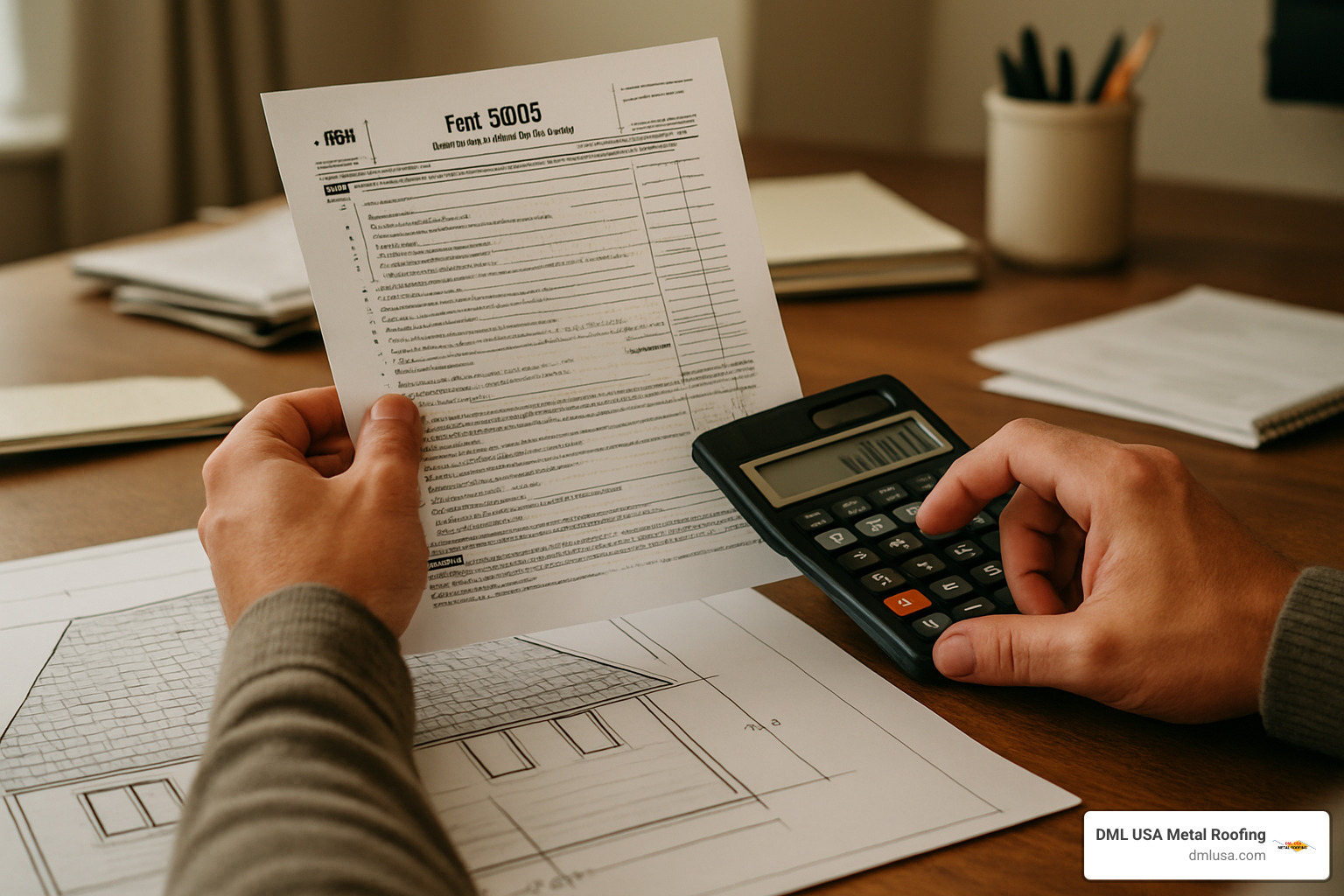
Good paperwork is the fastest way to turn your new roof into a smaller IRS bill.
Required records:
- Itemized contractor invoice separating materials and labor.
- Manufacturer2s certification (and the four-digit QM PIN starting in 2025).
- Receipts, spec sheets and permits.
Quick Filing Checklist
- Scan all documents for digital backup.
- Complete IRS Form 5695 Part II (Part I for solar). Enter only qualifying costs.
- Transfer the credit to Form 1040.
- Keep the records for at least three years.
Audit-Proof Tips
- Store receipts in cloud storage.
- Attach a home energy-audit report if you have one.
- Keep proof of contractor licensing and insurance.
Strategies for Extra Savings
- Schedule different upgrades in separate years to claim the $1,200 roofing credit more than once.
- Pair the roof with a heat pump and claim the $2,000 HVAC credit.
- Install an ENERGY STAR metal roof now and solar later; claim each credit when you incur the cost.
- Talk to a tax professional if you expect to carry forward part of the solar credit.
Find more details on our resources page or contact us for help.
Additional Tax Benefits & Real-World Scenarios
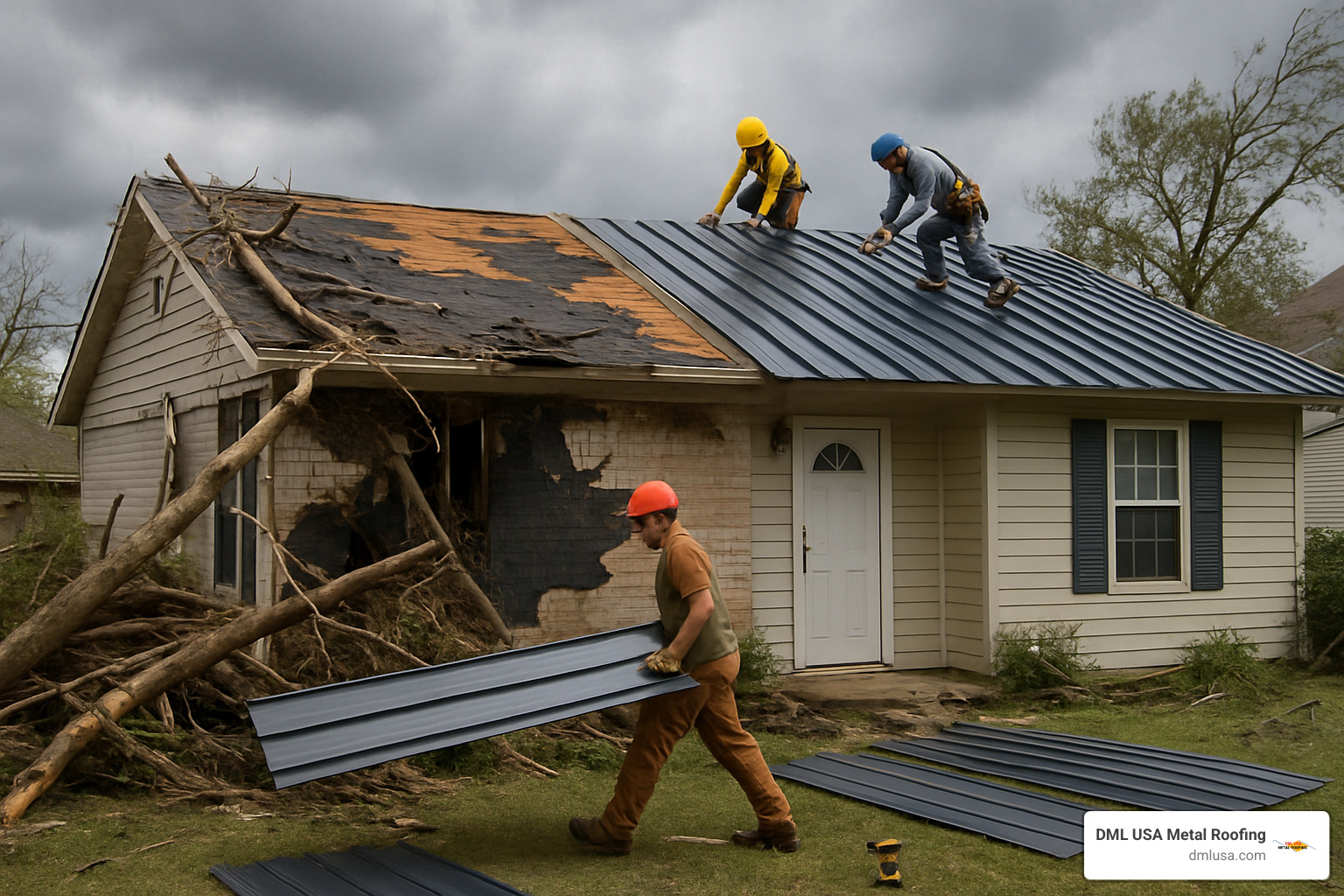
Beyond the main credits, a few lesser-known rules can stretch your dollars even further.
- Disaster relief: Costs not reimbursed after a federally declared disaster may be claimed as a casualty-loss deduction, separate from energy credits.
- Rental property: Owners can depreciate a new roof even though they cannot use the residential credit.
- Home office: Deduct the business-use percentage of roofing costs.
- Solar carry-forward: Unused Residential Clean Energy Credit rolls to future years.
Case Study: Solar Metal Roof, Chicago
Project cost: $25,000 (metal materials $15k, installation $5k, solar $5k)
Credits: $1,200 Energy Efficient Home Improvement + $3,000 Residential Clean Energy = $4,200 federal savings, plus ~$400/year lower cooling bills.
Case Study: Section 179 on a Commercial Roof
A factory spent $300,000 on a new roof. Electing Section 179 produced a $63,000 tax saving at the 21 % corporate rate.
Need help running the numbers for your property? Reach out to DML USA Metal Roofing today.
Frequently Asked Questions about Roofing Tax Credits
After helping hundreds of homeowners steer roofing tax credit applications over the years, I’ve noticed the same questions come up again and again. Here are the answers that matter most when you’re planning your roof upgrade.
What roofing materials qualify for the 30% credit?
The roofing tax credit is specific about which materials make the cut. ENERGY STAR certified materials are your golden ticket, and they include metal roofs with pigmented coatings that meet strict reflectance standards, asphalt shingles improved with cooling granules, and solar roofing tiles that actually generate electricity for your home.
Here’s what catches many people off guard: traditional asphalt shingles don’t qualify unless they have special cooling technology. The materials must meet specific Solar Reflectance Index (SRI) values – typically at least 25 for steep-slope roofs like most homes have.
Metal roofing is often the sweet spot because it naturally reflects more heat than traditional materials. When you combine that with the right pigmented coatings, you get both energy savings and tax credit eligibility. That’s why so many of our customers end up choosing metal – it’s like getting paid to upgrade to a superior roofing system.
Do installation costs ever count toward the roofing tax credit?
This is where things get a bit tricky, and it trips up a lot of homeowners. For the Energy Efficient Home Improvement Credit, only material costs qualify – labor and installation are completely excluded from the credit calculation.
But here’s the exception: solar roofing systems get special treatment. Under the Residential Clean Energy Credit, both materials and installation costs qualify for the full 30% credit with no upper limit. So if you’re installing solar shingles or planning to add solar panels to your new metal roof, that installation labor becomes part of your credit calculation.
This materials-only rule for regular roofing is why proper documentation matters so much. Your contractor needs to clearly separate material costs from labor on all invoices. We always make sure our customers get itemized receipts that break everything down clearly.
Can unused roofing tax credit amounts be carried forward?
The answer depends on which roofing tax credit you’re dealing with, and this distinction has real money implications.
The Energy Efficient Home Improvement Credit cannot be carried forward. If you can’t use the full amount in the year you claim it, those unused dollars are simply lost. This is why tax planning matters – you want to make sure you have enough tax liability to absorb the full credit.
The Residential Clean Energy Credit works differently. Unused amounts can be carried forward to future tax years until you’ve used every penny. This makes solar roofing systems much more flexible from a tax planning perspective.
It’s smart to run the numbers with your tax preparer before starting your project. Sometimes it makes sense to phase improvements across multiple years, especially if you’re planning other energy-efficient upgrades like heat pumps or windows. The goal is to maximize your total tax savings, not just grab the biggest credit in one year.
Conclusion & Next Steps
The roofing tax credit opportunity in front of you right now is genuinely exciting. Federal incentives make energy-efficient roofing more affordable than it’s been in years.
Think about it this way: the government is essentially offering to pay 30% of your qualifying roofing materials through 2032. That’s real money back in your pocket – not just a small deduction that saves you pennies on the dollar.
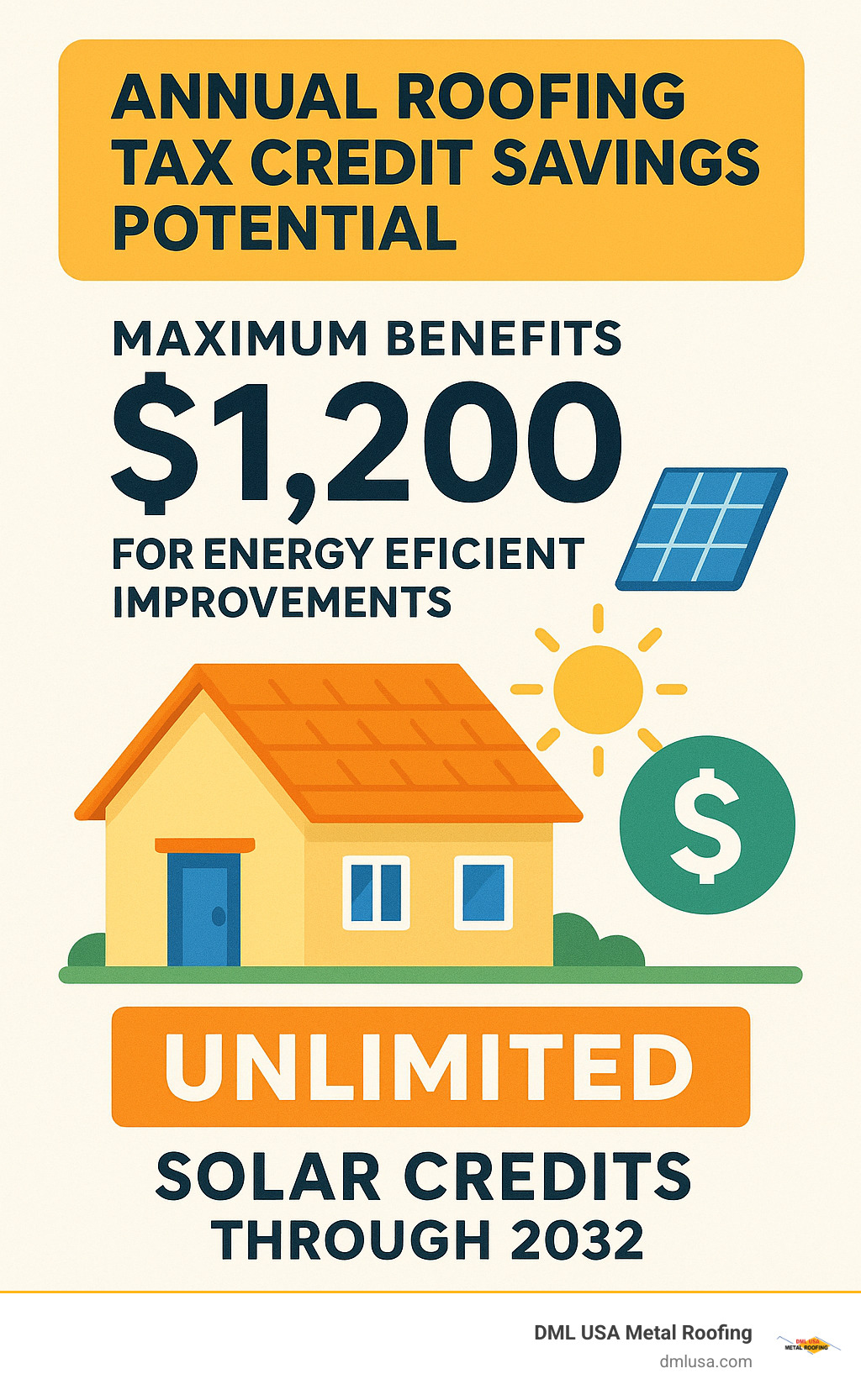
The math works beautifully when you choose the right materials. ENERGY STAR certified metal roofing can qualify for up to $1,200 in annual credits, while solar roofing systems get unlimited 30% credits. Add in the decades of energy savings and maintenance-free performance, and you’re looking at a smart investment that pays dividends for years.
But here’s the thing about timing – those credit rates start dropping in 2033. The difference between 30% and 22% might not sound huge, but on a $15,000 roofing project, that’s $1,200 you’d leave on the table by waiting too long.
The documentation process doesn’t have to be overwhelming either. Keep your receipts, get the manufacturer certifications, and file Form 5695 with your taxes. We’ve walked hundreds of customers through this process, and it’s more straightforward than most people expect.
At DML USA Metal Roofing, we’ve been helping Illinois homeowners make these smart roofing decisions since 2007. Our metal roofing systems are specifically designed to meet ENERGY STAR requirements while delivering the fire resistance, wind protection, and impact durability that makes metal roofing such a practical choice.
The sustainable savings from energy efficiency, combined with tax compliance benefits and the durability of quality metal roofing, create a compelling case for acting now rather than later.
Ready to turn these roofing tax credit opportunities into real savings on your home? Contact us to discuss how our energy-efficient metal roofing can qualify for federal credits while protecting your home for decades to come.
You can also explore our resources page for detailed information about our products and their energy efficiency ratings.
Don’t let these valuable federal incentives expire while you’re still dealing with an aging roof. The combination of immediate tax relief and long-term performance makes this the ideal time to invest in a metal roof that will serve your family well into the future.
