 Skip to main content

Can a new roof qualify for energy tax credit: Top 1
Understanding Energy Tax Credits for Your New Roof Investment
Can a new roof qualify for energy tax credit? The answer depends on the specific type of roofing materials you choose and which tax credit programs apply to your situation.
Quick Answer:
- Standard asphalt shingles: No federal tax credit
- Energy Star metal roofs with pigmented coatings: Up to $1,200 credit (30% of material costs)
- Asphalt roofs with cooling granules: Up to $1,200 credit (30% of material costs)
- Solar panels on metal roofs: 30% credit on total system cost (no cap)
- Labor costs: Only included for solar systems, not for roof materials
If you’re tired of dealing with frequent roof repairs and skyrocketing energy bills, understanding these tax incentives could save you thousands of dollars. The federal government offers two main programs: the Energy Efficient Home Improvement Credit (Section 25C) for qualifying roofing materials, and the Residential Clean Energy Credit (Section 25D) for solar installations.
Recent data shows that over 1.2 million taxpayers claimed around $6.3 billion in federal solar tax credits in 2023 alone, averaging over $5,000 per person. With the Inflation Reduction Act extending these credits through 2032, there’s never been a better time to invest in an energy-efficient roof that pays for itself.
As Adam Kadziola from DML USA Metal Roofing, I’ve helped hundreds of Illinois homeowners steer the question “can a new roof qualify for energy tax credit” while upgrading to durable, energy-efficient metal roofing systems. My experience in manufacturing and home renovations has shown me how the right roofing choice can deliver both immediate tax savings and long-term energy benefits.
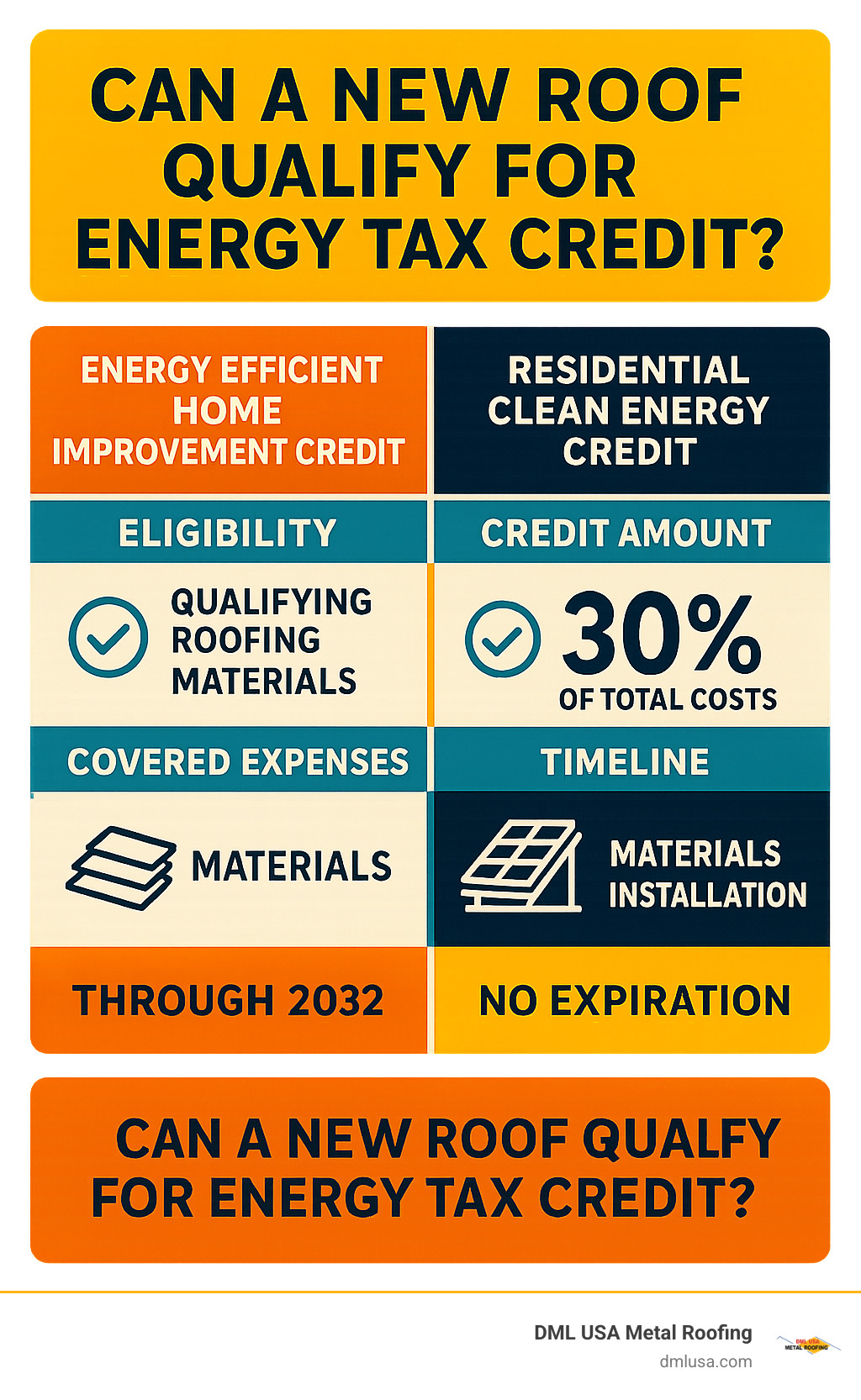
Can a new roof qualify for energy tax credit terms you need:
So, Can a New Roof Qualify for an Energy Tax Credit?
The short answer is: it depends entirely on what type of roof you’re installing. While most standard roof replacements don’t qualify for federal tax credits, specific energy-efficient roofing materials can open up significant savings through two distinct federal programs.
The key is understanding that can a new roof qualify for energy tax credit isn’t a yes-or-no question – it’s about choosing the right materials and knowing which programs apply to your situation.
| Credit Type | Energy Efficient Home Improvement Credit (25C) | Residential Clean Energy Credit (25D) |
|---|---|---|
| Credit Amount | 30% of material costs (up to $1,200 annually) | 30% of total project cost (no cap) |
| What’s Covered | Energy Star metal roofs, asphalt with cooling granules | Solar panel systems, battery storage |
| Eligible Property | Primary residence only | Primary and secondary residences |
| Labor Costs | Not included | Included |
| Duration | Through December 31, 2032 | Through December 31, 2034 |
Understanding the Difference: Tax Credits vs. Tax Deductions
Before we dive into which roofs qualify, let’s clear up a common confusion that could cost you thousands of dollars. Many homeowners mix up tax credits and tax deductions, but the difference is huge.
A tax credit is like getting a coupon for your tax bill – it reduces what you owe dollar-for-dollar. If you owe $3,000 in federal taxes and claim a $1,000 tax credit, you now owe only $2,000. It’s direct money back in your pocket.
A tax deduction works differently. It reduces your taxable income, which then gets multiplied by your tax bracket percentage. If you’re in the 22% tax bracket and claim a $1,000 deduction, you save $220 in taxes ($1,000 × 22% = $220).
Here’s why this matters for your roof: A $1,000 tax credit saves you $1,000, while a $1,000 tax deduction saves you only $220 if you’re in the 22% bracket. Tax credits are significantly more valuable, which is why the federal energy programs use credits instead of deductions.
The General Rule: Why Most Standard Roofs Don’t Qualify
Here’s the reality that catches many homeowners off guard: installing a standard asphalt shingle roof on your primary residence doesn’t qualify for any federal tax credits or deductions. The IRS classifies installing a new roof as a home improvement – a capital improvement that increases your home’s value.
This applies to most common roofing materials: standard asphalt shingles, basic metal roofing without energy-efficient coatings, wood shakes, clay tiles, and slate roofing. These are all considered structural components that add to your home’s cost basis for future sale calculations, but they don’t provide immediate tax benefits.
Think of it like renovating your kitchen – it adds value to your home but doesn’t reduce this year’s tax bill. The IRS sees most roofing as a necessary home maintenance expense that increases your property value, not an energy-efficiency upgrade worthy of tax incentives.
However, there’s good news: certain energy-efficient roofing materials do qualify for federal tax credits, and that’s where the real savings begin.
The Energy Efficient Home Improvement Credit (Section 25C)
Here’s where the answer to “can a new roof qualify for energy tax credit” gets exciting for homeowners. The Energy Efficient Home Improvement Credit, tucked away in Section 25C of the tax code, opens the door for substantial savings on specific energy-efficient roofing materials.
This credit isn’t just pocket change – it covers 30% of qualified expenses for improvements installed between January 1, 2023, and December 31, 2032. The best part? Unlike the old system that capped you at a measly $500 for your entire lifetime, the current program lets you claim up to $1,200 per year in credits for building envelope components like roofing.
Think of it as the government’s way of saying “thank you” for choosing materials that help reduce energy consumption nationwide.
What Specific Roofs Qualify for This Credit?
Not all roofs are created equal in the eyes of the IRS. Only two specific types of roofing materials make the cut for the Energy Efficient Home Improvement Credit:
Metal roofs with pigmented coatings that meet Energy Star standards and asphalt roofs with cooling granules that also meet Energy Star requirements. That’s it – no exceptions, no loopholes.
At DML USA Metal Roofing, we focus on that first category because metal roofs with advanced pigmented coatings are game-changers. These aren’t your grandfather’s metal roofs that absorbed heat like a frying pan. Our modern systems with cool-color coatings can drop your roof surface temperature by up to 100°F compared to traditional materials.
The magic happens through two key performance measures that Energy Star-certified products must meet: solar reflectance (how much sunlight bounces right off your roof) and thermal emittance (how efficiently your roof releases any heat it does absorb). Our metal roofing systems excel at both, which is exactly why they qualify for federal tax credits while delivering long-term energy savings.
How Much Can You Save and What Are the Limits?
The math here is beautifully straightforward. You get 30% of your material costs back as a credit, up to that annual cap of $1,200 for building envelope components.
Let’s say you invest $4,000 in qualifying metal roofing materials. Your credit calculation looks like this: $4,000 × 30% = $1,200. That’s $1,200 coming directly off your federal tax bill – not your taxable income, but your actual tax liability.
Here’s the smart part: since there’s no lifetime limit under the current program, you could potentially claim the full $1,200 credit each year through 2032 if you make qualifying improvements. Some savvy homeowners spread their energy-efficient upgrades across multiple years to maximize their total credits.
Are Labor Costs Included?
Here’s where I have to deliver some disappointing news. Labor costs don’t qualify for the Energy Efficient Home Improvement Credit when it comes to roofing materials. The credit only covers the cost of the materials themselves – not a penny of the installation expenses.
This is why getting itemized invoices becomes crucial. You need clear documentation that separates material costs from labor costs. When we provide estimates at DML USA Metal Roofing, we always break down these costs in detail. It helps our customers understand exactly what qualifies for the credit and ensures they have the proper documentation come tax time.
Don’t let this limitation discourage you though. Even with just the material costs qualifying, that 30% credit can still represent substantial savings on your roofing investment.
The Residential Clean Energy Credit (Section 25D)
While the Energy Efficient Home Improvement Credit helps with qualifying roofing materials, the Residential Clean Energy Credit opens up much bigger savings opportunities. This is where can a new roof qualify for energy tax credit becomes truly exciting for homeowners.
Section 25D of the tax code, also known as the Solar Investment Tax Credit (ITC), offers 30% back on your entire solar installation – with no annual cap and labor costs included. Think of it as the government’s way of encouraging clean energy adoption.
The beauty of this credit is its generosity. Unlike the $1,200 annual limit on roofing materials, solar installations can generate thousands of dollars in tax savings. I’ve seen homeowners save $8,000 or more on larger systems.
Solar Panels and Metal Roofs: A Powerful Combination
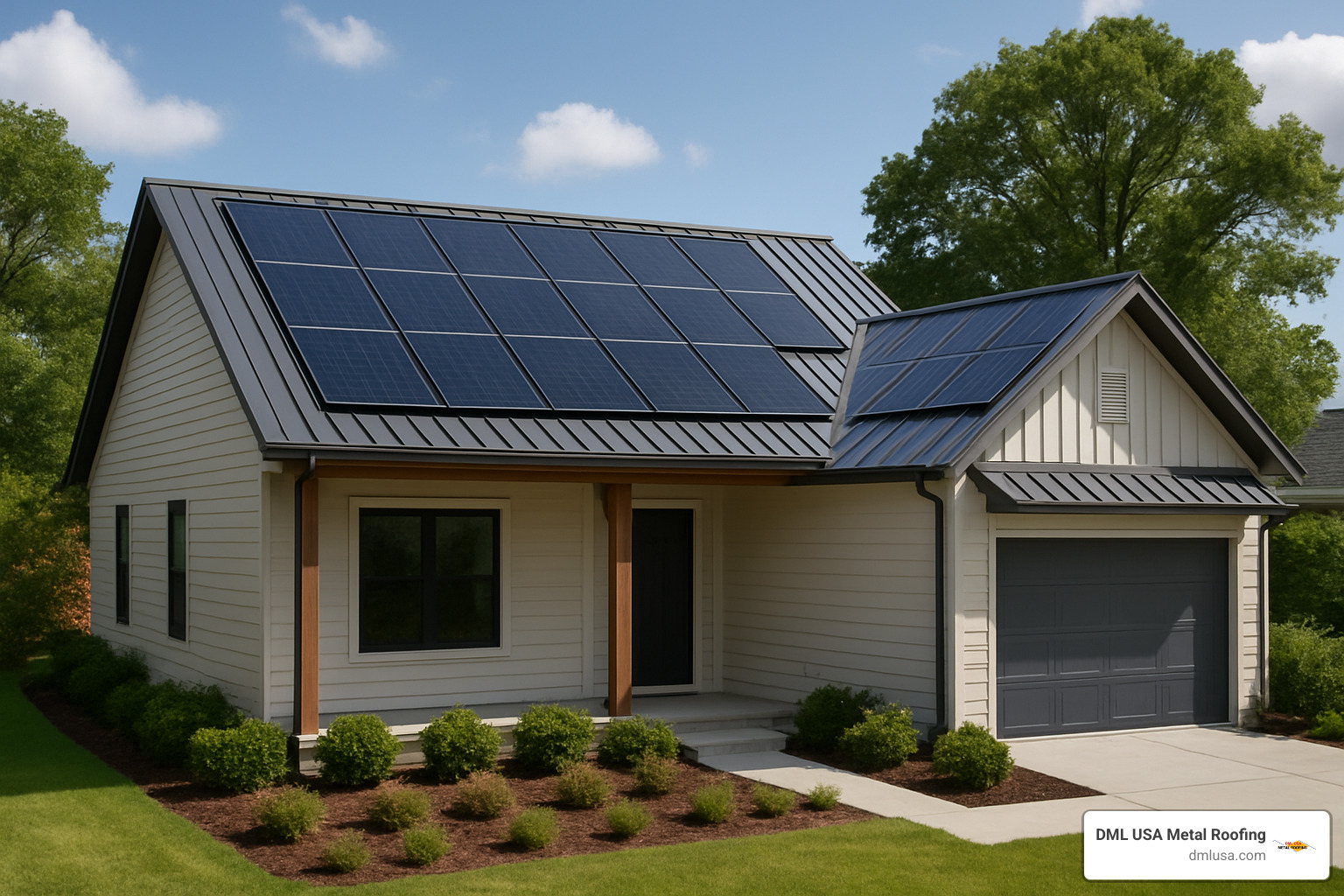
Here’s where our metal roofing expertise creates real value for homeowners. When you combine solar panels with a metal roof, you’re not just getting one system – you’re creating an integrated energy solution that qualifies for the full Residential Clean Energy credit.
Metal roofs and solar panels work together like peanut butter and jelly. The metal roof provides structural protection for decades while the solar panels generate clean electricity to power your home. This dual-functionality means your roof investment does double duty.
What makes this combination so smart? Metal roofs are incredibly durable and can easily support solar panel weight without the structural concerns you might have with other roofing materials. Plus, the reflective properties of our metal roofing help keep solar panels cooler, which actually improves their efficiency.
When you install solar panels on your metal roof, the entire solar system qualifies for the 30% credit. This includes solar panels, inverters, mounting hardware, electrical upgrades, battery storage technology (if charged primarily by solar), and even installation labor.
Understanding the 30% Credit and Its Phase-Down
The math on solar installations is straightforward and impressive. Install a $20,000 solar system on your metal roof, and you’ll receive a $6,000 federal tax credit. There’s no cap, so a $30,000 system means $9,000 back in your pocket.
This credit covers your total project cost – both materials and labor. That’s a huge advantage over the roofing materials credit, which only covers materials. Every dollar you spend on the solar installation, from the panels to the electrician’s time, counts toward your 30% savings.
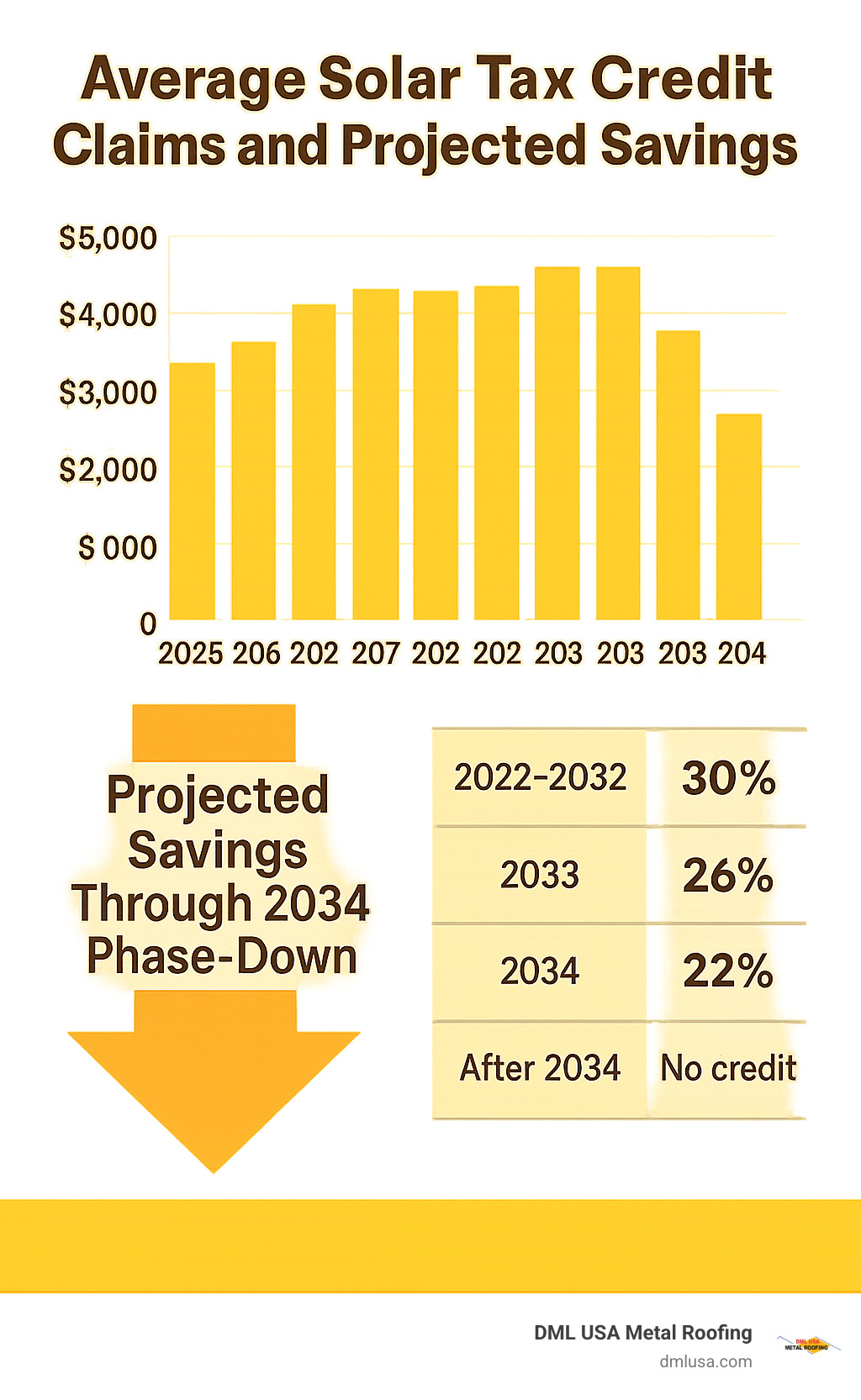
But here’s the catch: this generous credit won’t last forever. The phase-down schedule means waiting could cost you thousands. The credit drops to 26% in 2033, then 22% in 2034, and disappears completely after 2034.
Using our earlier example, a $20,000 system installed in 2025 saves you $6,000. Wait until 2033, and that same system only saves $5,200. By 2035, you’d get nothing. That’s why 2025 is such a sweet spot for combining a new metal roof with solar installation.
Other Tax Scenarios for Your New Roof
While we’ve covered the main energy tax credits, there are other situations where can a new roof qualify for energy tax credit or other tax benefits. These scenarios might not apply to every homeowner, but they could save you significant money if your situation fits.
What if the Roof is for a Rental Property or Home Business?
The tax rules completely flip when you’re not dealing with your primary residence. If you own rental property, that new roof suddenly becomes a business expense – and the IRS treats business expenses much more favorably than personal home improvements.
For rental properties, your roof replacement is considered a capital improvement that gets depreciated over 27.5 years. This means you can deduct a portion of the roof’s cost every single year as a business expense. Here’s how the math works out:
Let’s say you install a $15,000 metal roof on your rental property. You’d divide that cost by 27.5 years, giving you an annual depreciation expense of $545. If you’re in the 22% tax bracket, that translates to $120 in tax savings every year for the next 27.5 years.
The home office deduction opens up another opportunity. If you use part of your home exclusively for business – like a dedicated home office – you might be able to deduct a prorated portion of your roof replacement costs. The key word here is “exclusively.” That spare bedroom where you sometimes work doesn’t count if your kids also use it for homework.
The calculation is straightforward: if your home office represents 10% of your home’s square footage, you could potentially deduct 10% of your qualifying roof expenses as a business expense. Just make sure you can prove the space is used regularly and exclusively for business purposes.
Are There Tax Benefits for Roofs Damaged in Natural Disasters?
Unfortunately, Mother Nature doesn’t care about your tax planning. But if she damages your roof, the IRS might actually help you out – under very specific circumstances.
The casualty loss deduction applies when your roof is damaged by sudden, unexpected events in areas that receive federal disaster declarations. We’re talking about hurricane damage in Florida, wildfire damage in California, or severe storm damage in federally declared disaster zones.
The damage must be truly sudden and unexpected – not the gradual wear and tear that comes from 20 years of weather exposure. And it must occur in a federally declared disaster area, which you can verify through FEMA’s disaster declarations database.
Here’s the catch: you can only deduct un-reimbursed costs after insurance and other compensation. The deduction is also limited to the amount exceeding 10% of your adjusted gross income, minus $100 per casualty event. So if your adjusted gross income is $75,000, you’d need more than $7,500 in un-reimbursed losses before you could claim any deduction.
While nobody wants to deal with disaster damage, understanding these rules can help you recover some costs through tax savings when the unexpected happens.
How to Claim Your New Roof Energy Tax Credit
Now that you know can a new roof qualify for energy tax credit, let’s walk through the practical steps to actually claim those savings. Getting your credit approved isn’t complicated, but it does require proper documentation and following specific IRS procedures.
Think of it like getting a rebate on a major purchase – you need to keep your receipts and fill out the paperwork correctly. Miss a step, and you could lose out on thousands of dollars in savings.
What Documentation and Forms Are Needed?
The IRS wants proof that your roof actually qualifies for the credit. This means gathering several key documents before you file your taxes.
Your itemized invoices are crucial because they need to show material costs separately from labor costs. Only materials qualify for the Energy Efficient Home Improvement Credit, while solar installations can include both materials and labor. When we work with customers at DML USA Metal Roofing, we always provide detailed invoices that break down these costs clearly.
You’ll also need proof of payment – whether that’s receipts, bank statements, or credit card statements showing you actually paid for the work. The IRS wants to see money changed hands, not just estimates or contracts.
The Manufacturer’s Certification Statement proves your roofing materials meet Energy Star requirements. This document comes from the manufacturer and shows the specific energy efficiency ratings that qualify your roof for the credit. Don’t lose this – it’s your golden ticket to the credit.
Finally, keep your product specification sheets and installation date documentation to verify everything was completed in the correct tax year. If you install your roof in December 2024, you’ll claim the credit on your 2024 tax return.
The main form you’ll use is IRS Form 5695 (Residential Energy Credits). This form has two parts: Part I for solar systems (Residential Clean Energy Credit) and Part II for roofing materials (Energy Efficient Home Improvement Credit). You’ll attach this completed form to your Form 1040 when filing your federal tax return.
Here’s something new to watch for: starting in 2025, qualifying property must be produced by a qualified manufacturer and reported with a manufacturer’s PIN (Product Identification Number). Make sure your roofing contractor provides this information, or you might not be able to claim the credit.
How Long Will These Tax Credits Be Available?
The clock is ticking on these generous tax credits, but you still have plenty of time to plan your roofing investment.
The Energy Efficient Home Improvement Credit (Section 25C) runs through December 31, 2032. The good news? There’s no phase-down period – it stays at the full 30% rate until it expires. Your annual limit remains at $1,200 for roofing materials throughout this entire period.
The Residential Clean Energy Credit (Section 25D) for solar installations lasts a bit longer but starts shrinking sooner. It’s available through December 31, 2034, but phases down to 26% in 2033 and 22% in 2034. Since there’s no annual cap on this credit, the timing matters more for larger solar projects.
This timeline gives you a solid planning window, but don’t wait too long. The 30% solar credit begins its phase-down in just eight years, making the next few years optimal for combining a metal roof with solar panels.
At DML USA Metal Roofing, we always recommend that our Illinois customers consult with a qualified tax professional to make sure they’re maximizing their available credits and following all IRS requirements correctly. Tax rules can be tricky, and professional guidance ensures you don’t leave money on the table.
Conclusion
So, can a new roof qualify for energy tax credit? The answer is a resounding yes – but only when you make smart choices about materials and understand what the IRS actually allows.
After helping hundreds of Illinois homeowners steer these tax credits, I’ve seen how the right roofing decision can put thousands of dollars back in your pocket. Standard asphalt shingles won’t qualify for any federal tax credits, but Energy Star metal roofs with pigmented coatings can earn you up to $1,200 in annual credits through 2032.
The real game-changer is combining metal roofing with solar panels. This powerful combination qualifies for the 30% Residential Clean Energy Credit with no cap, covering both materials and labor costs. I’ve watched customers save $6,000 or more on $20,000 solar installations – money that goes straight back into their pockets, not the government’s.
Here’s what you need to remember: labor costs are only included for solar installations, not for roofing materials alone. And proper documentation is absolutely essential – keep those itemized invoices and manufacturer certifications, because the IRS will want to see them.
What excites me most about energy-efficient roofs is the double benefit they provide. You get immediate tax savings and long-term energy bill reductions. Our metal roofing systems at DML USA Metal Roofing deliver both, plus the added peace of mind that comes with fire resistance, wind resistance, and virtually no maintenance requirements.
The current tax credit programs are some of the most generous we’ve seen in decades. With the Inflation Reduction Act extending credits through 2032, you have a solid window to make these investments pay off. Whether you’re dealing with storm damage in Aurora or planning new construction in Rockford, now is an excellent time to invest in roofing that literally pays for itself.
I always tell my customers that tax laws can be tricky, and every situation is unique. Please consult with a qualified tax professional to make sure you’re maximizing your available credits and following all the IRS requirements correctly.
Ready to find how a new energy-efficient metal roof could slash both your tax bill and your energy costs? Let’s talk about your options and explore our roofing products that qualify for federal tax credits. Your wallet – and your home – will thank you.
