Skip to main content

False
The Enduring Value of a Well-Protected Metal Roof
Metal roof protection is essential for maximizing your investment and ensuring decades of reliable performance. Here’s what you need to know:
- Coatings: Factory-applied paint systems (Polyester, SMP, PVDF) provide UV resistance and corrosion protection
- Substrates: Galvalume outperforms galvanized steel with superior corrosion resistance
- Underlayments: Ice and water shields prevent moisture damage beneath panels
- Maintenance: Regular inspections and gentle cleaning extend coating life
- Energy Efficiency: Reflective coatings can reduce cooling costs by up to 40%
Metal roofs can last 40-70 years or even longer, significantly outlasting traditional asphalt shingles which typically last 15-30 years. However, this impressive longevity depends heavily on the protective systems that shield your metal panels from the elements.
Without proper protection, even the most durable metal roofing can face premature failure. UV rays, moisture, temperature fluctuations, and corrosion can all compromise your roof’s integrity and appearance over time. The key to maximizing your metal roof’s lifespan lies in understanding and implementing the right protective measures.
Cool metal roofing can offset the urban heat island effect by reflecting direct sunlight and heat, potentially lowering energy costs up to 40%. When properly protected with high-quality coatings and installed with appropriate underlayments, a metal roof offers far less maintenance needs and can save an estimated 60% over its lifespan compared to other roofing materials.
I’m Adam Kadziola, and with years of experience at DML USA Metal Roofing, I’ve learned the most effective metal roof protection strategies for Illinois homes. In this guide, I’ll share essential knowledge to protect your investment and ensure your metal roof delivers maximum performance for decades.
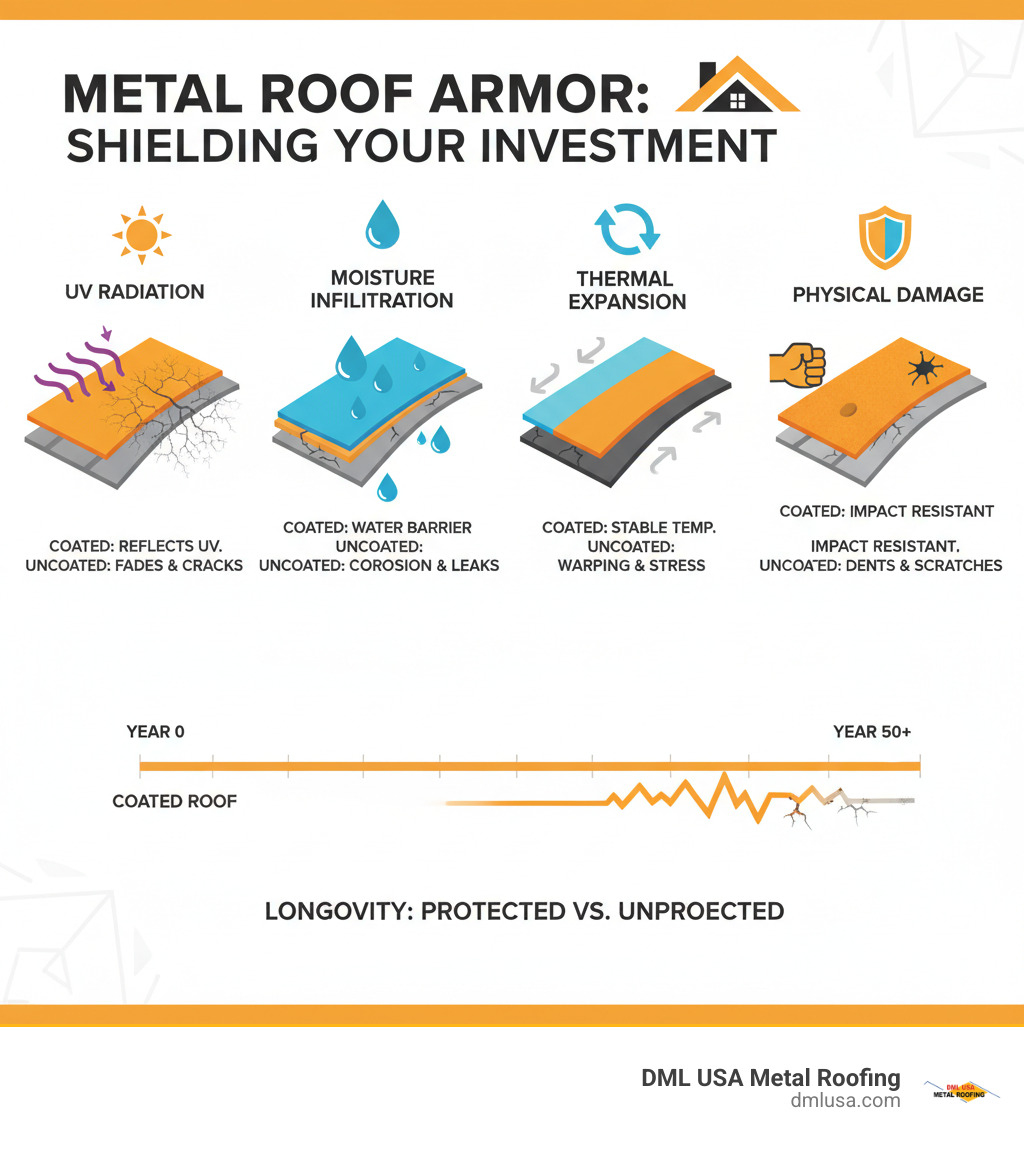
Basic metal roof protection terms:
Understanding Metal Roof Coatings: Your First Line of Defense
Think of metal roof protection coatings as your roof’s personal bodyguard. They’re constantly on duty, shielding your investment from everything Mother Nature throws at it – blazing sun, driving rain, hail, and those brutal Illinois winters we know all too well.
These protective layers do so much more than just make your roof look good (though they certainly do that too). They’re your primary defense against corrosion, the silent enemy that can turn a beautiful metal roof into a rusty eyesore. They also resist weathering from UV rays and temperature swings, helping your roof maintain its strength and appearance for decades longer than it would without protection.
Here’s the thing that really gets me excited about quality coatings: they’re one of the smartest investments you can make. There’s an upfront cost, but when you consider that a good coating can extend your roof’s lifespan by 20-30 years or more, the math becomes pretty compelling. You’re looking at spending a fraction of what a full roof replacement would cost while getting decades of additional protection.
Factory-Applied Paint Systems
When we manufacture metal panels, we apply these coatings in controlled factory conditions – think of it as giving your roof a professional spa treatment before it even reaches your home. These factory-applied systems are baked on at high temperatures, creating an incredibly durable bond that becomes part of the panel itself.
Polyester coatings are the budget-friendly option, but honestly, they’re not something we typically recommend for homes. They’ll start showing their age pretty quickly – fading and chalking within just a few years. For a roof that’s supposed to protect your family for decades, it’s worth investing in something better.
Silicone-Modified Polyester (SMP) coatings step up the game significantly. These systems give you much better color retention and chalk resistance compared to basic polyester. They’re a solid middle-ground choice that many homeowners find hits the sweet spot between performance and price. You can expect warranties of 10-20 years with SMP systems.
But when you want the absolute best, Polyvinylidene Fluoride (PVDF) coatings are in a league of their own. I’ve seen eight-year-old roofs with PVDF finishes that still look like they were installed yesterday – no fading, no chalking, just that fresh, vibrant appearance. These fluoropolymer systems are incredibly stable and can come with warranties extending 35-40 years or more.
| Coating Type | Durability | Color Retention | Chalk Resistance | Typical Warranty |
|---|---|---|---|---|
| Polyester | Low | Low | Low | Short |
| SMP | Medium | Medium | Medium | 10-20 years |
| PVDF | High | High | High | 35-40+ years |
More info about our durable finishes.
DML USA Metal Roofing Restoration and Recoating Solutions
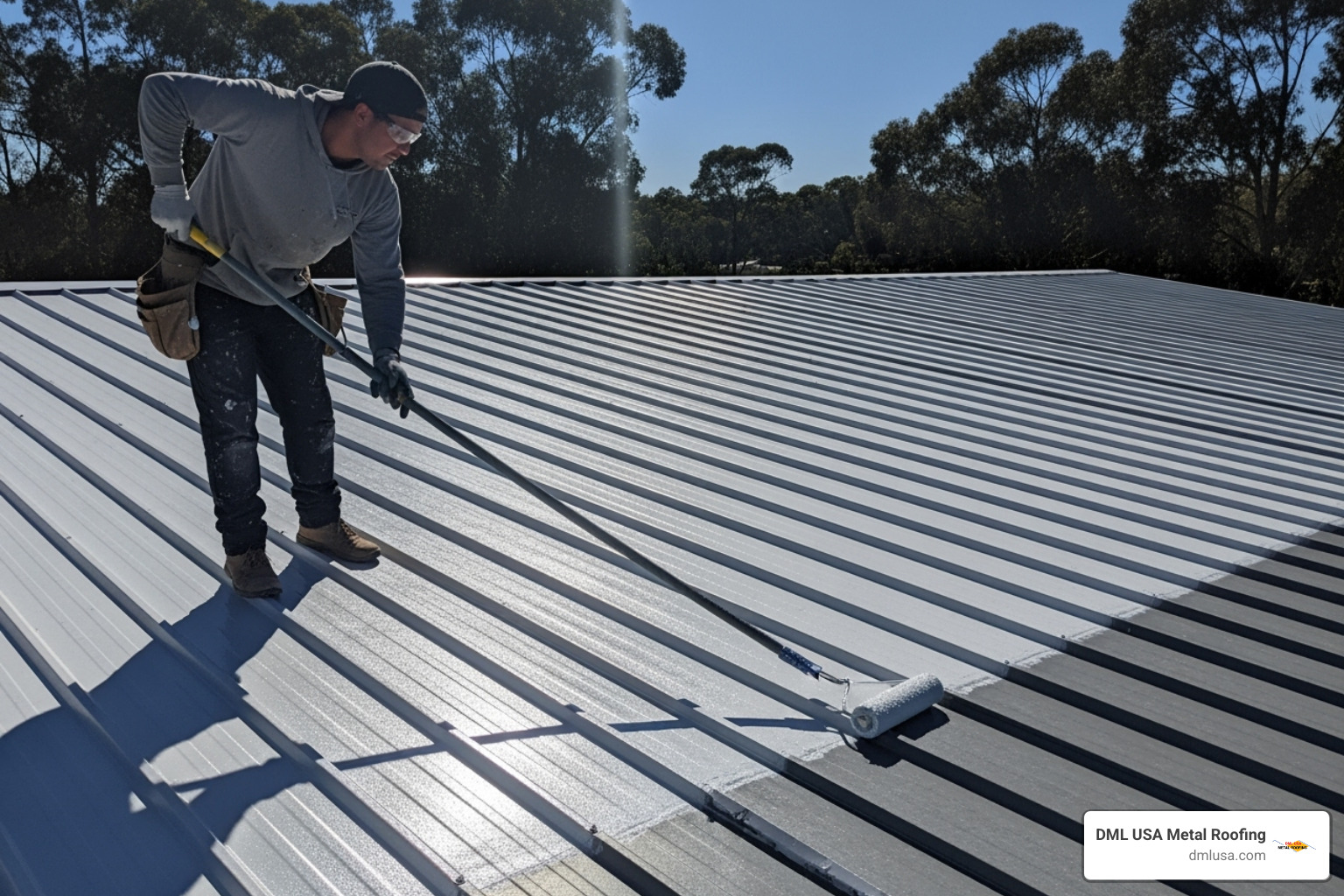
Sometimes the best metal roof protection strategy isn’t starting from scratch – it’s giving your existing roof a second life. If your metal roof is structurally sound but showing some wear like fading or minor surface rust, recoating can be absolutely transformative.
We typically recommend rubber (SEBS) coatings for most restoration projects. These Styrene-Ethylene-Butylene-Styrene systems are like giving your roof superpowers. They’re incredibly flexible, which is crucial because metal roofs expand and contract dramatically with temperature changes. This flexibility means the coating moves with your roof instead of cracking or peeling away.
What really impresses me about rubber coatings is their versatility. They handle ponding water like champs, resist corrosion and rust, provide fire resistance, and even help keep your roof cooler. Plus, they’re relatively low-maintenance once applied – more time enjoying your home, less time worrying about your roof.
Silicone coatings offer another excellent option, especially if you’re working with a tighter budget. They provide outstanding water resistance and UV protection while reflecting heat effectively. While they might not handle extreme thermal movement quite as well as rubber systems, they’re still a solid choice for many Illinois homes.
The beauty of recoating is that it extends your roof’s service life at a fraction of the cost of replacement. We’re talking about potentially adding 15-25 years to your roof’s lifespan while refreshing its appearance and protective qualities.
Key Factors for Choosing the Right Metal Roof Coating
Selecting the perfect coating for your specific situation requires considering several important factors. Durability tops the list – you want a coating that will maintain its protective qualities through years of Illinois weather extremes.
UV resistance is absolutely critical, especially since metal roofs are fully exposed to the sun’s rays all day long. Without proper UV protection, even the most expensive coating will start breaking down, fading, and chalking within a few years.
Flexibility and elongation properties matter tremendously for metal roofs. When temperatures swing from summer highs in the 90s to winter lows well below zero, your metal panels are constantly expanding and contracting. Your coating needs to move with them seamlessly.
Adhesion properties determine whether your coating will stay put or start peeling and blistering. Proper surface preparation and application are crucial, but the coating itself must be formulated to bond well with metal substrates.
Your local climate and weather conditions should heavily influence your choice. Here in Illinois, we deal with everything from intense summer heat to brutal winter cold, plus hail, heavy snow, and ice storms. Hot climates benefit most from reflective cool roof coatings, while cold climates need coatings that handle freeze-thaw cycles without cracking. If you’re in an area prone to ponding water, rubber coatings are typically your best bet.
A guide to metal roof paint systems.
The Energy Efficiency of ‘Cool Roof’ Coatings
Here’s where metal roof protection gets really exciting from an energy savings perspective. Cool roof coatings are designed with high Solar Reflectance Index (SRI) values, meaning they bounce a significant portion of the sun’s heat away from your building instead of absorbing it.
The energy savings can be substantial – we’re talking about potentially reducing cooling costs by up to 40%. In a place like Chicago during those sweltering summer months, that translates to real money staying in your pocket instead of going to the utility company.
These reflective coatings also help combat the urban heat island effect, where cities become significantly hotter than surrounding rural areas due to all the heat-absorbing surfaces. By choosing a cool roof coating, you’re not just saving money – you’re contributing to a more sustainable environment for everyone.
More about Energy Star certified panels.
The Foundation of Metal Roof Protection: Substrates and Underlayments
Think of your metal roof like a well-built house – you need a solid foundation before you can add the finishing touches. While those beautiful coatings we just discussed are certainly important, the real strength of metal roof protection starts with what lies beneath: the substrate metal itself and the underlayment that creates a secondary barrier against moisture.
The base metal you choose will determine how well your roof stands up to corrosion over the decades. And that underlayment? It’s your insurance policy against moisture damage, condensation issues, and those sneaky leaks that can develop from ice dams or storm damage.
Galvanized vs. Galvalume Substrates
Here’s where things get interesting – not all metal substrates are created equal. At DML USA, we work with two main types, and understanding the difference can save you thousands of dollars in the long run.
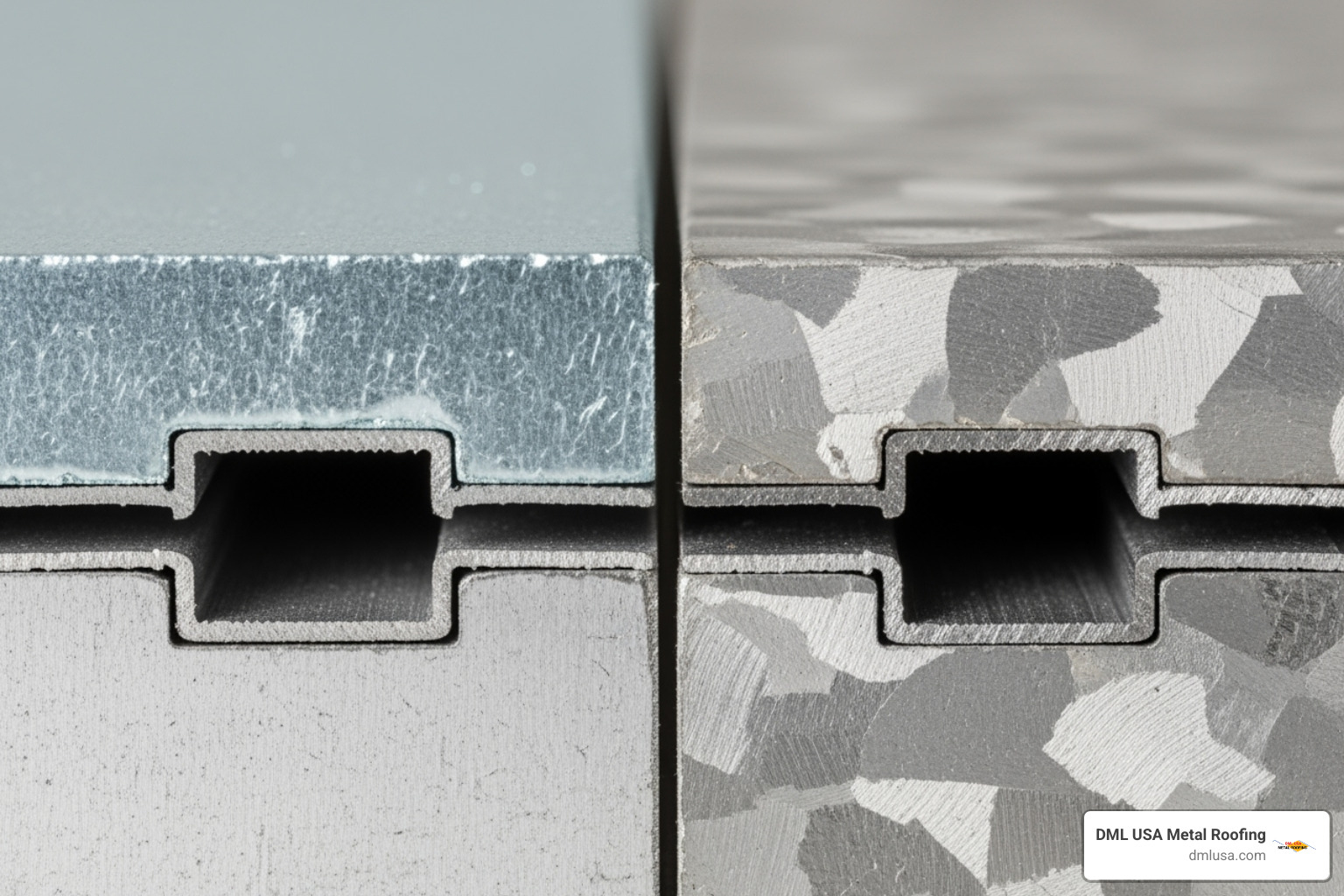
Galvanized steel panels get their protection from a pure zinc coating. Think of zinc as the bodyguard for your steel – it literally sacrifices itself to protect the steel underneath from corrosion. But here’s the catch: not all galvanized coatings are the same.
You’ll see designations like G60 and G100, and these numbers matter more than you might think. G100 contains 66% more zinc than G60, which translates directly to longer protection. We honestly don’t recommend G60 for residential roofing – it’s just not enough protection for something as important as your home’s roof. If you’re going with galvanized, G100 is the absolute minimum we’d suggest.
Galvalume substrates take protection to the next level with a zinc-aluminum alloy coating. This isn’t just marketing speak – the combination of zinc and aluminum creates superior corrosion resistance that consistently outperforms galvanized steel. Galvalume panels often come with stronger warranties and maintain their appearance longer, making them our top recommendation for metal roof protection.
The science is pretty straightforward: Galvalume simply lasts longer and looks better over time. For Illinois homes dealing with everything from humid summers to harsh winters, that extra protection is worth every penny.
The difference between Galvanized and Galvalume.
Essential Underlayments and Membranes
Now let’s talk about what goes under those metal panels – the unsung heroes of your roofing system. These protective layers work around the clock to prevent moisture problems that could damage your home from the inside out.
High-temperature ice and water shields are absolutely essential here in Illinois. We’ve all seen what ice dams can do to a roof, and high-quality ice and water shields are specifically designed to handle our challenging climate. These self-adhesive membranes seal tightly around nails and screws – those common weak points where leaks love to start.
What makes these shields special is their ability to handle temperatures up to 250 degrees Fahrenheit without failing. Special features create superior sealing around fasteners, while others prevent tearing during installation and extreme weather. We always install these shields around eaves, valleys, and any roof penetrations. Just remember – even these tough shields shouldn’t sit exposed to sunlight for more than 60 days before your metal panels go on.
Condensation control is another critical piece of the metal roof protection puzzle. When warm, moist air inside your home meets cold metal surfaces, you get condensation – and that can mean water damage over time.
Specialized condensation control membranes tackle this problem by trapping about one quart of condensation per 10 square feet in specially designed pockets. They are often bacteria-resistant, UL 723 classified, and can even reduce rain noise by about 20% – a nice bonus for those heavy Illinois thunderstorms. These membranes can come with 20-year adhesion warranties, so you know they’ll stay put.
Other systems work similarly by absorbing water into their fibers right at the dew point, holding it safely until temperatures rise and it can evaporate naturally. Both systems require proper ventilation to work effectively – the trapped moisture needs somewhere to go when conditions allow it to dry out.
We always emphasize proper installation of these condensation barriers, including field-treating the membrane with heat at laps and edges. This prevents capillary action that could allow moisture to wick where it shouldn’t go.
These underlayments aren’t optional extras – they’re fundamental components that turn a good metal roof into a truly protected system that will serve your family for decades to come.
Best Practices for Coating Application and Long-Term Maintenance
Even the highest quality coatings and substrates need proper installation and care to deliver on their promise of longevity. Think of it like buying a luxury car – you wouldn’t skip the oil changes and expect it to run perfectly for decades, right? The same principle applies to metal roof protection.
When we apply coatings at DML USA, we’ve learned that cutting corners during installation almost always leads to headaches down the road. A coating that’s applied incorrectly might look fine initially, but it won’t provide the protection you’re paying for. That’s why we follow strict protocols for every project.
Proper Application for Lasting Metal Roof Protection
The difference between a coating that lasts 5 years versus 20 years often comes down to preparation and application technique. We’ve seen too many roofs where someone tried to take shortcuts, and the results are never pretty.
Surface inspection is where everything starts. We thoroughly examine the roof for structural damage, loose fasteners, or existing coating failures. You can’t build a strong foundation on a weak base, and the same goes for roof coatings.
Power washing comes next, and this step is absolutely critical. Any dirt, debris, chalk, or loose paint will prevent proper adhesion. We use specialized equipment to ensure every square inch is clean without damaging the existing surface.
When we encounter rust removal and treatment, we don’t just paint over the problem. Loose rust gets completely removed, and we apply a rust-inhibitive primer to neutralize any remaining corrosion. This creates a stable surface that won’t continue deteriorating under the new coating.
Seam and fastener sealing is where attention to detail really matters. Metal roofs have numerous potential entry points for water, and each one needs careful sealing with appropriate materials before the main coating goes on.
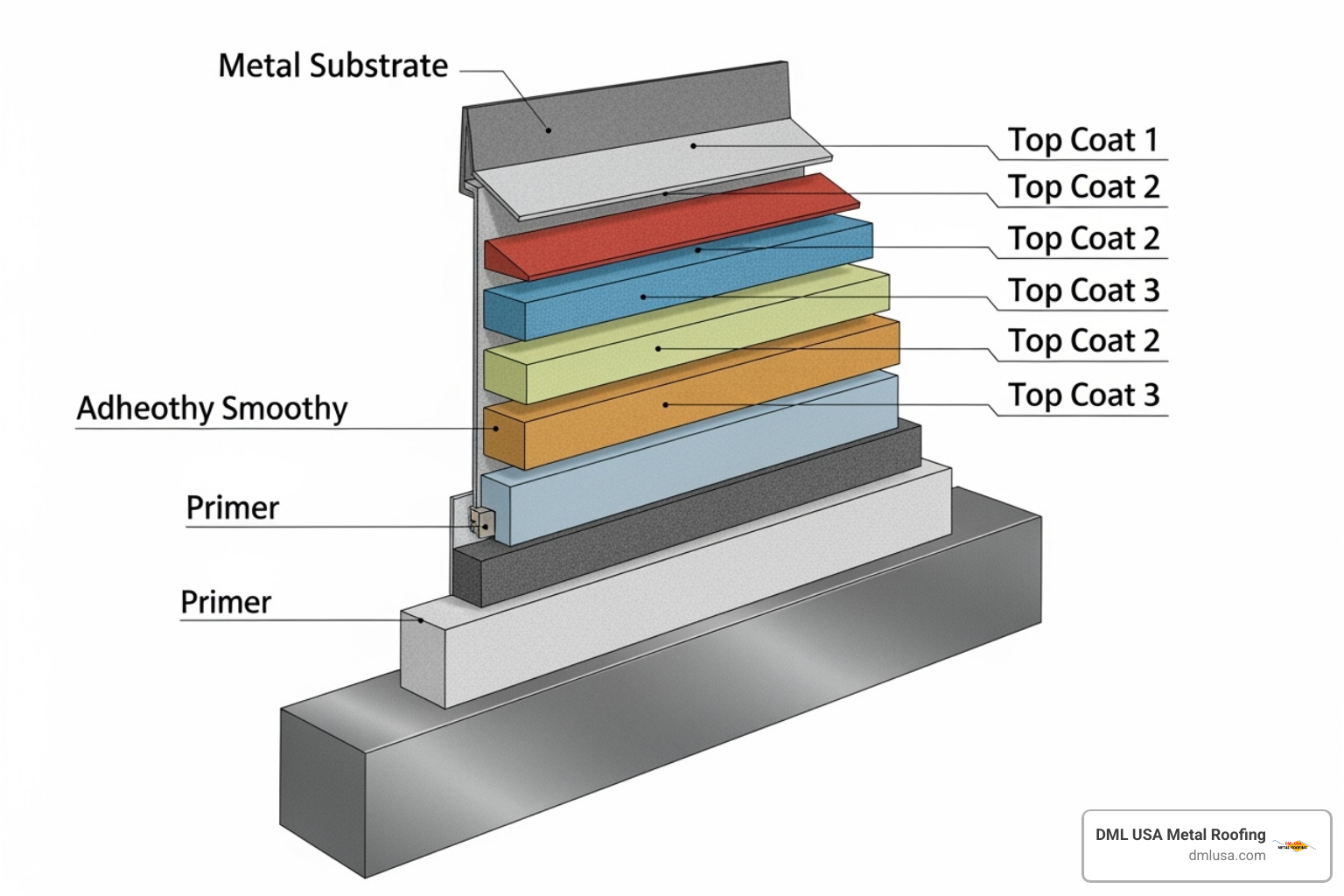
The primer application might seem like an extra step, but it’s the bridge between your metal substrate and the protective top coat. We use primers specifically designed for metal roofs to ensure maximum adhesion and longevity.
For the top coat application, we apply the chosen coating in even, consistent layers. Whether we’re using rubber, silicone, or another system, achieving the proper mil thickness is crucial for protection. We typically use spraying or rolling methods, depending on the product and your roof’s profile.
Curing times are non-negotiable. We know you’re eager to see the finished product, but rushing this step compromises everything we’ve worked to achieve. Adequate drying time – often 24 hours or more – is essential for optimal performance.
Maintaining Your Coated Metal Roof
Once your metal roof protection is in place, a little ongoing care goes a long way. We like to tell our customers that maintaining a coated metal roof is easier than maintaining a traditional asphalt roof, but it’s not maintenance-free.
Annual inspections should become part of your home maintenance routine, ideally in spring or fall when the weather’s cooperative. Look for peeling, blistering, or cracking in the coating, accumulated debris like leaves or branches that could trap moisture, loose or missing fasteners, rust spots especially around penetrations or edges, and damage from severe weather like hail or falling branches.
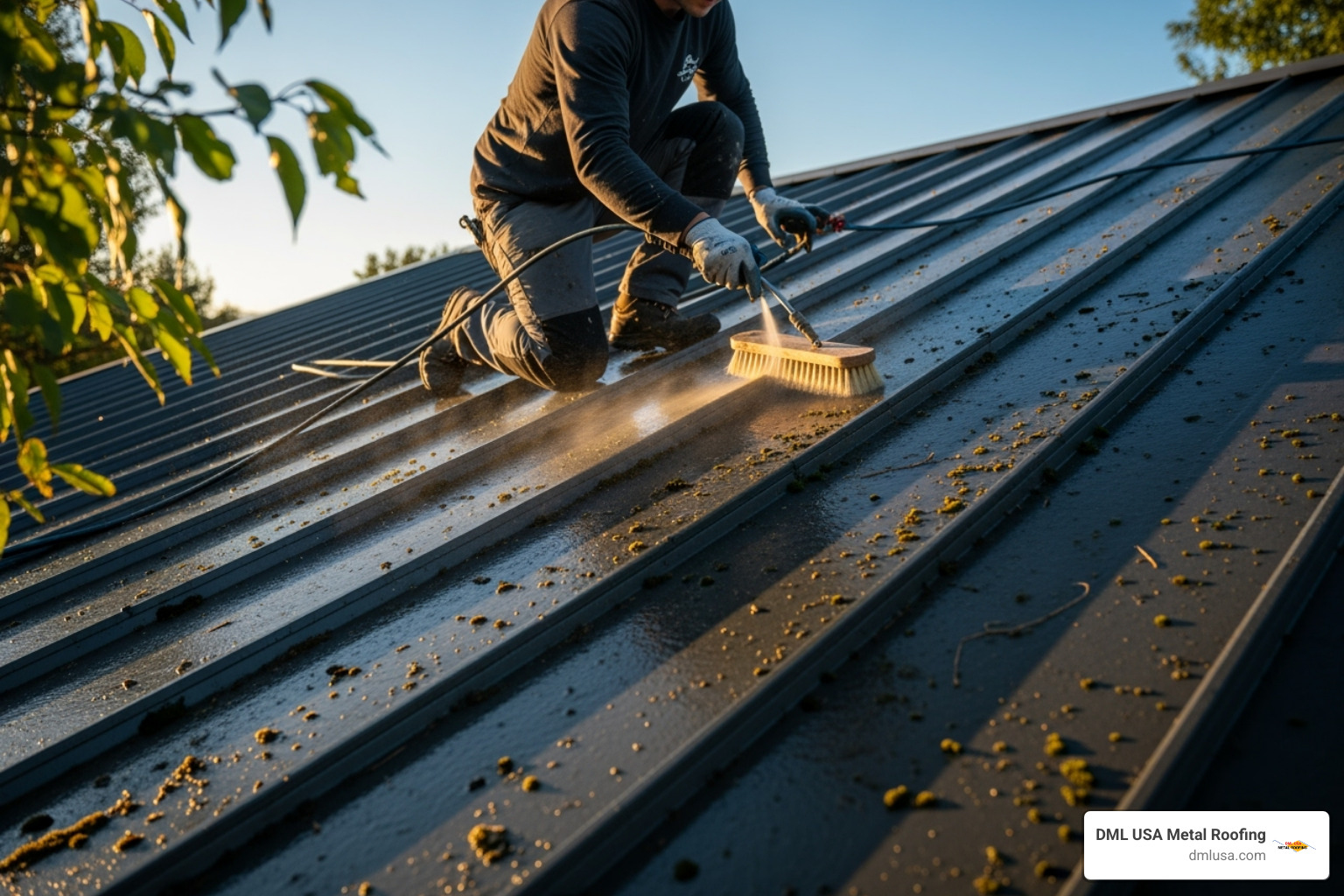
Gentle cleaning keeps your roof looking great and functioning properly. A simple hose-down with water works for most situations. If you need more cleaning power, use a soft brush with mild, non-abrasive detergent – dish soap works perfectly. Always rinse thoroughly afterward.
Here’s what NOT to do: never use abrasive cleaners, wire brushes, or harsh chemicals like bleach or strong acids on your coated metal roof. These can damage the coating, compromise its protective properties, and potentially void your warranty. We’ve seen expensive coating jobs ruined by well-meaning homeowners who used the wrong cleaning products.
Promptly addressing minor damage is like treating a small cut before it becomes infected. Small scratches, loose fasteners, or minor coating issues can quickly escalate if ignored. Touch-up kits are often available for specific coatings, allowing for quick repairs that maintain your roof’s integrity.
Your coated metal roof is designed to handle Illinois weather extremes, from scorching summers to brutal winters. With proper application and basic maintenance, it should provide decades of reliable protection for your home and family.
Frequently Asked Questions about Metal Roof Protection
Over the years, we’ve helped countless Illinois homeowners understand metal roof protection, and certain questions come up again and again. Let me share the answers to the most common concerns we hear.
How long do metal roof coatings last?
This is probably the question I get asked most often, and the answer depends on what type of coating we’re talking about.
Factory-applied finishes are built to go the distance. PVDF coatings are the real champions here – these premium finishes can maintain their like-new appearance for decades. We’re talking about 35 to 40-year warranties for color retention and chalk resistance. I’ve personally seen eight-year-old roofs with PVDF coatings that still look like they were installed yesterday.
SMP (Silicone-Modified Polyester) coatings offer solid performance for 10 to 20 years, though you’ll notice some fading and chalking over time compared to PVDF. They’re still a reliable choice for many homeowners.
When it comes to DML USA’s recommended restoration coatings – both rubber and silicone – proper application to a well-prepared surface can add 10 to 20 years or more to your metal roof’s lifespan. These coatings essentially give your existing roof a fresh start, creating a new protective barrier that’s watertight and durable.
Several factors influence how long your coating will last. UV exposure intensity, temperature extremes, hail frequency, and how well you maintain your roof all play important roles. Here in Illinois, where we experience everything from scorching summers to brutal winters, choosing the right coating and maintaining it properly makes all the difference.
Can you coat a rusty metal roof?
Absolutely! This is one of those situations where proper preparation makes all the difference between success and disappointment.
You cannot simply paint over rust and expect lasting metal roof protection. The rust will continue to spread underneath, eventually causing the new coating to fail. However, with the right approach, even a rusty roof can be restored to excellent condition.
Here’s what needs to happen: First, we thoroughly power wash the roof to remove all dirt, grease, and loose debris. Then comes the critical step – all loose, flaky, or actively corroding rust must be removed. This might involve wire brushing, sanding, or using specialized rust treatment products.
Once the surface is clean and stable, we apply a high-quality rust-inhibitive primer specifically designed for metal roofing. This primer does double duty – it chemically treats any remaining microscopic rust and creates a surface that bonds perfectly with the top coat. Skip this step, and you’re asking for trouble.
After the primer has properly cured, we apply the chosen protective top coat, whether it’s rubber or silicone. The result is a roof that’s often better protected than it was when new.
That said, there are limits. If rust has caused widespread perforation or compromised the structural integrity of your metal panels, coating might not be your best option. In these severe cases, replacement of affected panels or the entire roof becomes the smarter long-term investment.
What is the best coating for a metal roof with ponding water?
Ponding water is a serious concern that can accelerate corrosion, cause leaks, and destroy even the best coatings prematurely. While no coating can fix poor drainage, some handle standing water much better than others.
For metal roofs that experience ponding water, rubber (SEBS) coatings are our top recommendation. These coatings excel in wet conditions because of their high tensile strength and exceptional elongation properties. They create a flexible, seamless membrane that resists constant water exposure far better than other coating types.
Think of rubber coatings as creating a pond liner on your roof – they’re specifically engineered to handle water that doesn’t drain immediately. This makes them ideal for low-slope areas or roofs with minor drainage issues.
However, I always tell homeowners that coatings are protective measures, not drainage solutions. While a quality rubber coating can prevent immediate problems and buy you valuable time, the best long-term approach is addressing the root cause of ponding water.
This might mean re-sloping sections of your roof, adding tapered insulation, or improving your gutter system to ensure water flows off efficiently. We always recommend evaluating and correcting structural drainage issues before applying any coating. It’s like fixing a leaky bucket – you want to patch the hole, not just put a better liner inside.
The bottom line? A rubber coating can protect your roof from ponding water damage, but combining it with proper drainage improvements gives you the most reliable long-term metal roof protection.
Secure Your Investment with Superior Metal Roof Protection
Throughout this guide, we’ve explored the essential elements that make metal roof protection a cornerstone of smart homeownership. From factory-applied PVDF coatings that maintain their pristine appearance for decades to the hidden heroes like Galvalume substrates and ice barriers working tirelessly beneath your panels, every component plays a vital role in your roof’s success story.
The journey of protecting your metal roof begins with understanding that coatings serve as your primary defense system. Whether you choose a high-performance PVDF finish for new construction or opt for one of our recommended rubber restoration coatings to breathe new life into an aging roof, these protective layers are what stand between your home and Illinois’s unpredictable weather patterns.
But protection goes deeper than what meets the eye. The importance of quality substrates and underlayments cannot be overstated. A Galvalume substrate provides that crucial foundation of corrosion resistance, while properly installed ice and water shields prevent those sneaky moisture problems that can cause headaches down the road. It’s like building a fortress – every layer matters.
Perhaps most importantly, we’ve learned that proper maintenance transforms good protection into exceptional longevity. A gentle annual cleaning and quick inspection can spot small issues before they become expensive problems. Even the toughest coating needs a little TLC to perform at its best.
The math is compelling: when you invest in comprehensive metal roof protection, you’re not just buying peace of mind – you’re securing decades of reliable performance, energy savings, and protection for everything beneath your roof. It’s an investment that pays dividends every single day.
For high-quality, durable metal roofing systems designed specifically for Illinois’s challenging climate, DML USA Metal Roofing offers solutions that truly deliver. From Arlington Heights to Chicago, Crystal Lake and beyond, we’re proud to provide our neighbors with maintenance-free performance, energy tax credits, and exceptional resistance to fire, wind, and impact damage.
Explore our metal roofing products.