

Metal Roofing Compared to Shingles: 7 Powerful Reasons 2025
Why Metal Roofing Compared to Shingles is Today’s Hottest Home Improvement Debate
Metal roofing compared to shingles represents one of the biggest decisions homeowners face when replacing their roof. With 5 million roof replacements happening annually in the United States, more homeowners are ditching traditional asphalt shingles for metal alternatives.
Quick Comparison: Metal vs. Shingles
| Factor | Metal Roofing | Asphalt Shingles |
|---|---|---|
| Lifespan | 40-70 years | 15-30 years |
| Cost per sq ft | $4-$30 | $4-$20 |
| Wind resistance | Up to 140 mph | Up to 130 mph |
| Fire rating | Class A | Class C |
| Energy savings | 7-25% cooling costs | Minimal |
| Recyclability | 95% recycled content | 12 million tons to landfills yearly |
The numbers tell a compelling story. While asphalt shingles still cover about 80% of U.S. homes, metal roofing has doubled in popularity over just four years to claim 12% of the remodeling market. Meanwhile, asphalt shingle shipments declined more than 20% between 2022 and 2023.
This shift isn’t just about trends – it’s about value. Metal roofs can recover 85-95% of installation costs at resale, while lasting up to three times longer than shingles. For homeowners tired of replacing roofs every 12-20 years, metal represents a potential last roof solution.
The environmental impact adds another layer to consider. Nearly 95% of aluminum roofing comes from recycled materials, while 12 million tons of old asphalt shingles hit U.S. landfills annually – equivalent to filling 3,068 Olympic-size swimming pools with waste.
I’m Adam Kadziola, and through my years of experience manufacturing high-quality metal roofing at DML USA Metal Roofing since 2007, I’ve helped thousands of homeowners steer the metal roofing compared to shingles decision. In this guide, I’ll break down everything you need to make the right choice for your home and budget.
Simple metal roofing compared to shingles word guide:
– metal shingle roof cost
– cost difference between metal roof and shingle roof
Metal Roofing Compared to Shingles: Fast Facts
When you start researching metal roofing compared to shingles, the differences are pretty eye-opening. I’ve seen thousands of homeowners go through this exact comparison, and they’re always surprised by what they find.
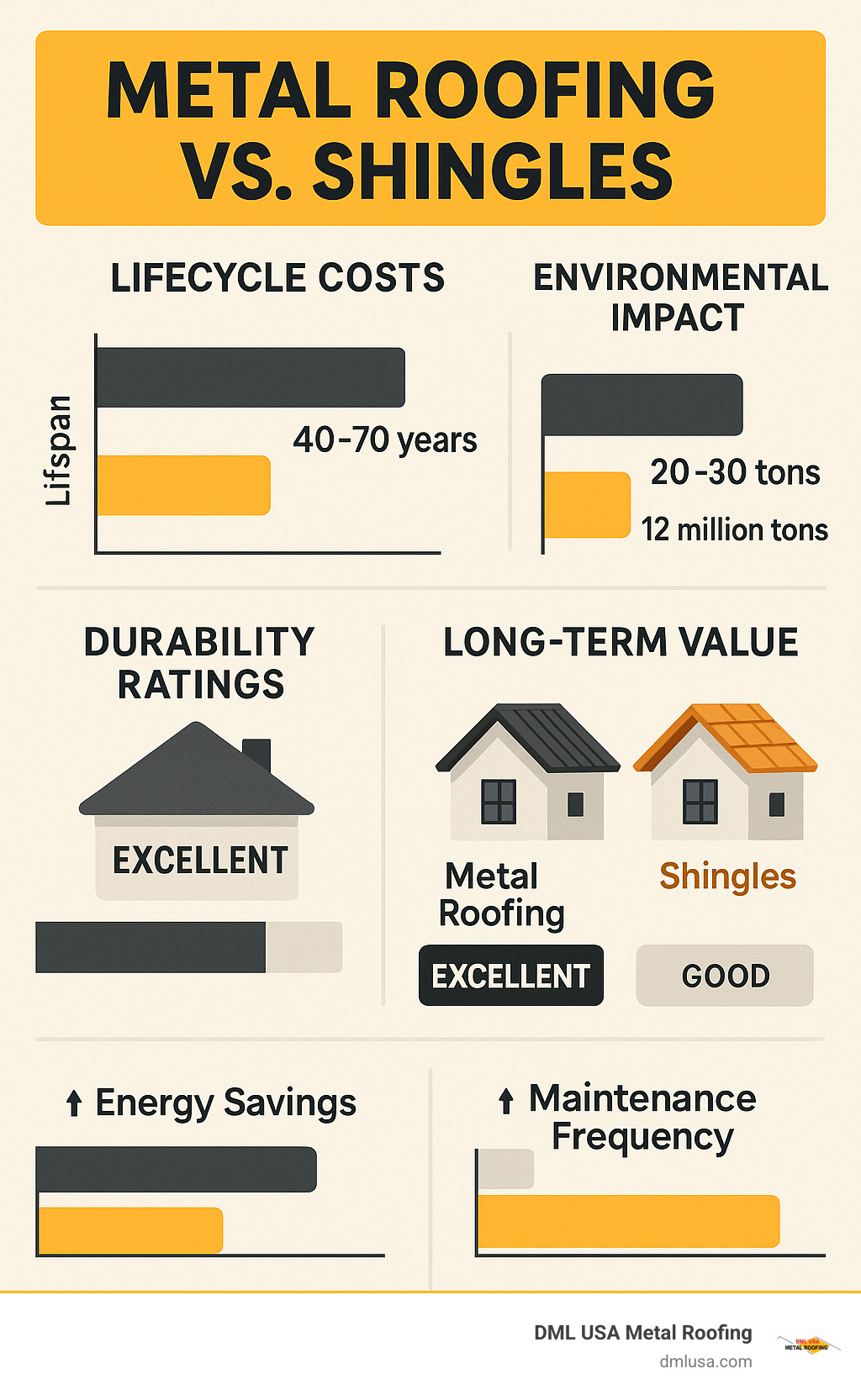
Here’s what really matters: metal roofs last 40-70 years while asphalt shingles typically give you 15-30 years. Some copper roofs I’ve seen are still going strong after 100 years, while I’ve watched homeowners replace shingle roofs that barely made it to their 12th birthday.
The weight difference might shock you too. Metal roofing weighs just 42 pounds per 100 square feet – that’s actually 50% lighter than asphalt shingles and 75% lighter than concrete tiles. This means you can often install metal right over your existing shingles without worrying about your roof structure.
Style options have completely changed the game. The old days of metal roofing meaning “barn roof” are long gone. Today’s metal roofing comes in over 250 standard colors and can look like traditional shingles, clay tiles, slate, or even wood shakes. Asphalt shingles offer their own variety with three-tab, architectural, and designer styles, but metal’s versatility often surprises people.
The environmental story tells itself. Nearly 95% of aluminum roofing contains recycled materials, and when your metal roof finally reaches the end of its very long life, it’s 100% recyclable. Meanwhile, 11 million tons of asphalt shingles hit landfills every year, taking up to 300 years to break down.
Why the surge in searches for “metal roofing compared to shingles”?
The explosion in homeowners researching metal roofing compared to shingles isn’t happening by accident. Rising asphalt prices have narrowed the cost gap between the two materials, making metal more competitive than it’s ever been.
Homeowners are also getting smarter about their investments. Instead of just looking at upfront costs, they’re calculating total lifetime value. When you realize you might replace asphalt shingles three times during the life of one metal roof, the math starts making sense.
Climate change has homeowners thinking differently too. Extreme weather events are becoming more common, and people want roofing that can handle 140 mph winds, resist Class 4 hail damage, and provide Class A fire protection – all standard features you get with quality metal roofing.
Word-of-mouth recommendations from satisfied customers drive much of this growth. When your neighbor installs a metal roof and raves about lower energy bills and zero maintenance headaches, you start paying attention.
Metal roofing compared to shingles in today’s market share
Asphalt shingles still rule the residential roofing world with about 80% market share, but that dominance is starting to crack. Metal roofing has captured roughly 12% of the remodeling market, which represents a huge shift from just a few years ago.
The trend becomes crystal clear when you look at shipping numbers. Asphalt roofing product shipments dropped more than 20% between 2022 and 2023, while metal roofing installations keep climbing. This suggests homeowners are fundamentally changing how they think about roofing, especially those planning to stay in their homes long-term.
The infamous “Shingle Mountain” in Dallas – a massive landfill containing millions of tons of discarded asphalt shingles – has become an unwitting poster child for the environmental cost of frequent roof replacements. It’s just one more reason homeowners are considering longer-lasting alternatives.
Cost, Energy & Lifetime Value Showdown
When it comes to metal roofing compared to shingles, the money conversation gets interesting fast. Metal costs more upfront – sometimes double or triple what you’d pay for asphalt shingles. But here’s the thing: focusing only on that initial price tag is like judging a car solely by its sticker price while ignoring gas mileage, repairs, and how long it’ll last.
The real story unfolds over decades. A typical asphalt shingle roof runs $5,000-$10,000 for an average home, while metal roofing lands between $8,000-$25,000 depending on your material choice and roof complexity. That 2-3x cost difference makes plenty of homeowners pump the brakes on metal – and I get it. Nobody likes spending more money upfront.
But here’s where the math gets exciting. Metal roofing’s reflective properties can slash your cooling costs by 7-25%, with some Department of Energy studies showing savings up to 30% in hot climates. Those cool roof pigments and thermal emittance technology help metal roofs release absorbed heat instead of dumping it into your home like a giant radiator.
At DML USA Metal Roofing, we’ve watched homeowners in Illinois cut their summer cooling bills by $200-400 annually with our energy-efficient systems. Over 50 years, these savings alone can offset a huge chunk of that initial cost difference.
The perks don’t stop there. Many metal roofing systems qualify for federal energy tax credits, potentially saving you thousands. Plus, insurance companies often hand out 10-15% discounts for metal roofing because they know it laughs at fire, wind, and hail damage that makes asphalt shingles cry for help.
For more detailed information about the benefits of choosing metal roofing, visit our why choose metal roofing page.
Initial price of metal roofing compared to shingles
Let’s break down where your money actually goes when comparing metal roofing compared to shingles:
Basic asphalt shingles cost $4-$8 per square foot for materials, while architectural shingles bump that up to $7-$13 per square foot. Standing seam metal runs $10-$16 per square foot, corrugated metal sits at $4-$7 per square foot, and premium metal shingles land between $8-$14 per square foot.
Labor tells a similar story. Metal roofing installation requires specialized skills, typically costing $300-$500 per square (that’s 100 square feet) compared to $200-$300 per square for asphalt shingles. The catch? Metal crews often work faster once they hit their rhythm, which can help offset some of those labor cost differences.
Here’s where metal roofing pulls a neat trick – it’s often light enough to install right over your existing shingles. This “recover” installation saves you $1-$5 per square foot in tear-off and disposal costs while keeping those old shingles out of landfills. Your wallet and the environment both win.
Total ownership cost: metal roofing compared to shingles over 50 years
The lifetime cost analysis is where metal roofing really flexes its muscles. Let’s look at a typical 2,500 square foot roof over 50 years and see what happens.
With a shingle roof, you’re looking at an initial installation of $12,000. Around year 20, you’ll need replacement #1 at about $15,000 (thanks, inflation). Year 40 brings replacement #2 at roughly $19,000. Toss in $200 annually for maintenance and repairs, and your total 50-year cost hits $56,000.
Now for the metal roof scenario. You start with a $22,000 initial installation – ouch, right? But then the magic happens. Energy savings of $300 yearly over 50 years equals $15,000 back in your pocket. Insurance discounts of $150 annually add up to $7,500 over five decades. Minimal maintenance runs just $50 yearly, totaling $2,500 over the roof’s lifetime. Your total 50-year cost? Just $32,000.
That’s a $24,000 savings over 50 years while getting superior performance the entire time. Not too shabby for spending more upfront.
The resale value sweetens the deal even more. Homes with metal roofs can recover 85-95% of installation costs at resale, translating to a 1-6% boost in home value. Compare that to asphalt shingles, which typically recover about 61% of installation costs according to Remodeling Magazine’s Cost vs. Value report.
For insights on how roof type impacts insurance, check out this Progressive homeowners insurance insights resource.
Durability, Weather Resistance & Safety
When it comes to standing up to Mother Nature’s worst, metal roofing compared to shingles shows dramatic performance differences. We’ve seen this in our Illinois operations, where severe weather tests roofing materials regularly.
Wind Resistance Champions
Metal roofing systems can withstand winds up to 140 mph when properly installed, compared to asphalt shingles’ typical 70-130 mph rating. The interlocking seam design and secure fastening systems give metal roofing superior uplift resistance.
During severe storms, we’ve observed that properly installed metal roofing rarely experiences wind damage, while shingle roofs in the same area often lose individual shingles or entire sections.
Hail Impact Performance
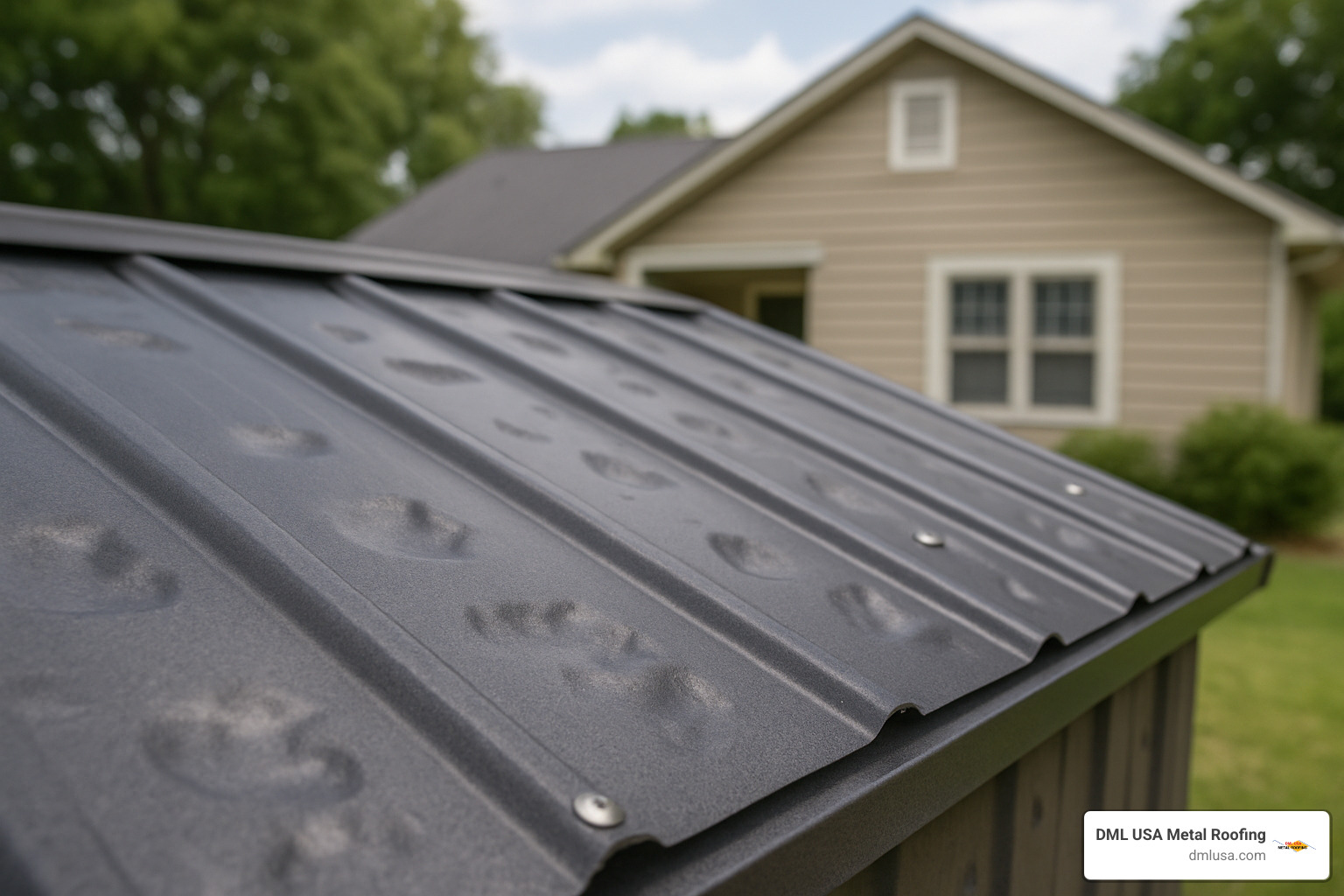
Class 4 impact resistance – the highest rating available – comes standard with most metal roofing systems. This means metal roofing can withstand golf ball-sized hail (2-inch diameter) without structural damage. While cosmetic denting may occur, the roof’s protective function remains intact.
Asphalt shingles, particularly basic three-tab varieties, can be damaged by quarter-sized hail. Even architectural shingles may suffer granule loss and eventual leaking after repeated hail exposure.
Fire Safety Superiority
Metal roofing carries a Class A fire rating – the highest available – because it’s completely non-combustible. This has proven crucial in wildfire-prone areas, where metal roofs have helped homes survive when neighboring structures with combustible roofing materials were lost.
Asphalt shingles typically carry a Class C fire rating due to their petroleum-based composition, making them more vulnerable to fire damage and ember penetration.
Extreme-weather lab tests: metal roofing compared to shingles
Independent testing by organizations like the Insurance Institute for Business & Home Safety (IBHS) consistently shows metal roofing’s superior performance:
UL 2218 Impact Testing
This standardized test drops steel balls of various sizes onto roofing materials. Metal roofing systems regularly pass Class 4 testing (2-inch steel ball dropped from 20 feet), while many asphalt shingles fail at lower impact levels.
Miami-Dade Wind Testing
In hurricane-prone Florida, Miami-Dade County requires stringent wind testing. Metal roofing systems routinely pass these tests, qualifying for use in High Velocity Hurricane Zones where wind speeds can exceed 180 mph.
Wildfire Ember Testing
Recent California wildfires have highlighted the importance of ember-resistant roofing. Metal roofing’s non-combustible surface prevents ember penetration, while asphalt shingles can ignite and spread fire to the structure below.
Safety perks beyond storms
Lightning Strike Myths Debunked
Contrary to popular belief, metal roofing doesn’t attract lightning strikes. Lightning seeks the highest point and the path of least resistance to ground – factors unrelated to roofing material. If lightning does strike a metal roof, the non-combustible material safely conducts the energy to ground without igniting.
Algae and Mold Resistance
Metal roofing’s smooth surface and lack of organic materials prevent algae, mold, and mildew growth. This contrasts sharply with asphalt shingles, which can develop unsightly black streaks from Gloeocapsa magma algae, particularly in humid climates.
Snow and Ice Management
Metal roofing’s smooth surface allows snow and ice to slide off naturally, preventing dangerous ice dam formation. However, this requires proper snow retention systems in areas with heavy snowfall to prevent sudden snow slides that could damage property or injure people below.
Installation, Maintenance & Resale Considerations
Getting a new roof installed brings its own set of challenges, and metal roofing compared to shingles reveals some interesting differences in how these projects unfold. After years of working with contractors across Illinois, I’ve seen how installation approaches vary dramatically between these two materials.
The Installation Timeline Reality
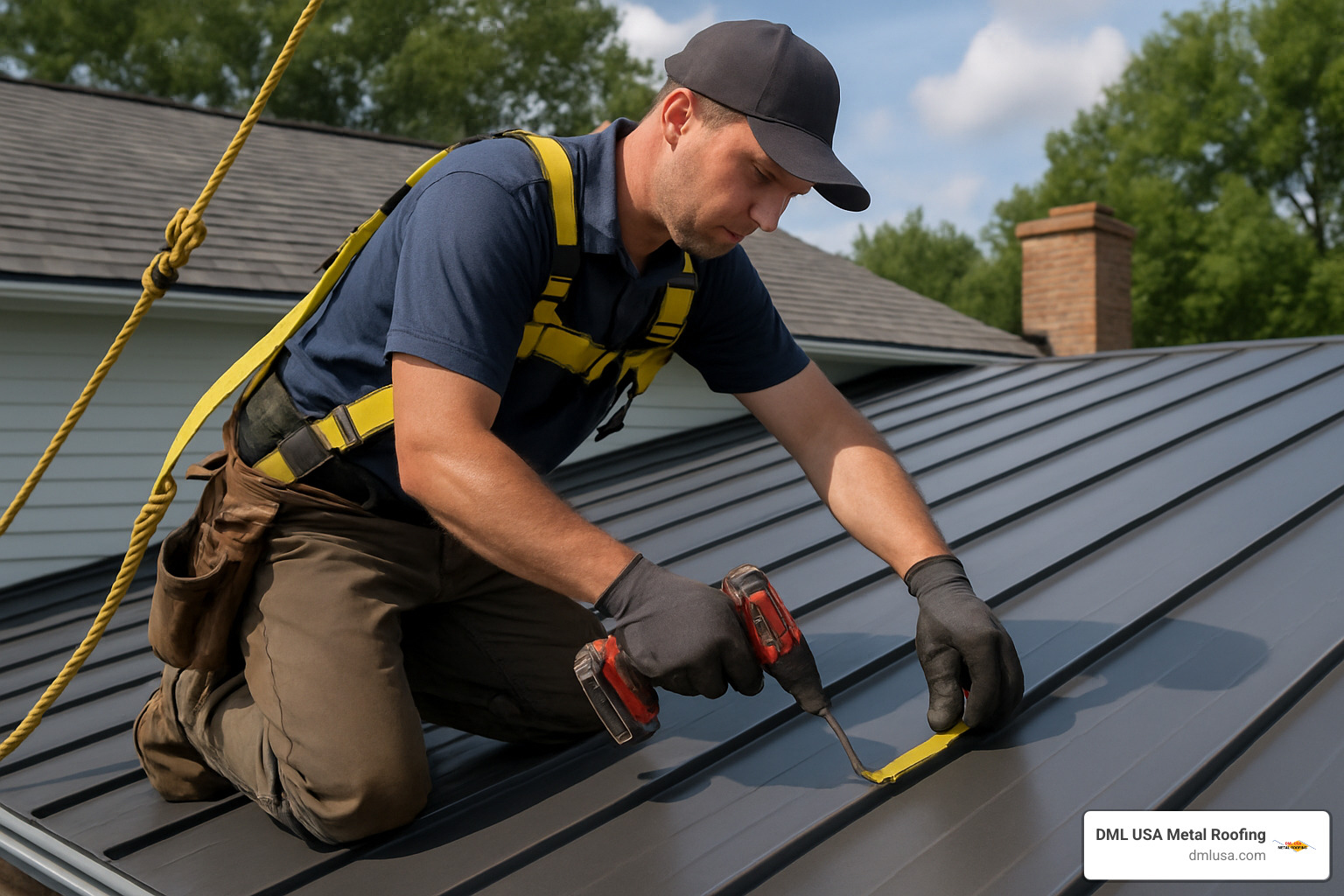
Most homeowners expect their roofing project to wrap up quickly, but metal roofing typically adds 1-3 days to the installation compared to asphalt shingles. This isn’t because metal roofing is harder to install – it’s because precision matters more.
Every measurement needs to be exact. Every fastener requires proper placement. Thermal expansion joints must be correctly positioned. These details take time but prevent problems down the road that could cost thousands to fix.
Asphalt shingles offer more forgiveness during installation. A slightly misplaced nail or imperfect alignment rarely causes major issues. This makes shingle installation more DIY-friendly for handy homeowners, though professional installation still delivers better results.
The Skilled Labor Factor
Here’s where many homeowners hit their first surprise – not every roofing contractor can properly install metal roofing. The specialized knowledge required means you’ll need to find contractors experienced with metal systems.
At DML USA Metal Roofing, we’ve invested heavily in contractor training because improper installation can turn a premium roofing system into a nightmare of leaks and noise. The good news? Once you find a qualified installer, the job typically goes smoothly and efficiently.
Retrofitting Over Existing Shingles
One of metal roofing’s biggest advantages is the ability to install directly over your existing shingle roof. Since metal weighs about 50% less than asphalt shingles, most homes can handle the combined weight without structural modifications.
This “recover” approach saves you $1-5 per square foot in tear-off costs while keeping old shingles out of landfills. Your existing shingles actually provide extra insulation and sound dampening – a win-win situation.
Navigating HOA Rules and Neighborhood Aesthetics
Some homeowners worry their HOA will reject metal roofing, but modern metal systems often fly under the radar. Today’s metal shingles can perfectly mimic traditional asphalt, slate, or tile appearances while delivering superior performance.
The key is choosing the right style for your neighborhood. Standing seam might stand out in a traditional subdivision, while metal shingles that look identical to asphalt often satisfy even the pickiest architectural review boards.
Solar Panel Mounting Advantages
If you’re considering solar panels now or in the future, metal roofing – especially standing seam systems – offers a huge advantage. Solar panels can attach directly to the raised seams without penetrating the roof surface.
This maintains your roof’s weather integrity and warranty coverage while providing rock-solid mounting for your solar investment. With asphalt shingles, every solar mount requires drilling through the roof, creating potential leak points.
FAQs – Metal Roofing Compared to Shingles (quick answers)
Will my metal roof sound like a drum during rainstorms?
This concern comes up in almost every conversation about metal roofing compared to shingles. The truth is, properly installed metal roofing with decking, insulation, and underlayment sounds just as quiet as asphalt shingles during rain.
The “noisy metal roof” myth comes from old barn roofs installed directly over open rafters without any sound-dampening materials. Your home’s construction naturally provides the layers needed for quiet operation.
Can I still install solar panels on both roof types?
Absolutely, but metal roofing makes solar installation cleaner and more secure. Standing seam metal allows solar panels to attach without roof penetrations, while asphalt shingle installations require drilling mounting holes that could potentially leak over time.
What about the shorter lifespan worry with shingles?
This is the reality many homeowners face after choosing asphalt shingles. While manufacturers advertise 20-30 year lifespans, real-world performance often falls short. We regularly see shingle roofs needing replacement after just 12-15 years, especially in areas with severe weather.
This frequent replacement cycle is exactly why many homeowners eventually switch to metal roofing – they’re tired of dealing with roof problems every decade or two.
Repair & upkeep math
The ongoing maintenance story reveals another significant difference when examining metal roofing compared to shingles. Most homeowners don’t factor maintenance costs into their initial decision, but these expenses add up quickly over time.
Annual Metal Roofing Maintenance Tasks:
Your yearly to-do list stays refreshingly simple: inspect the roof visually for any obvious issues, clear debris from gutters and roof valleys, and rinse the surface with a garden hose if needed. Most homeowners handle these tasks themselves for free, or pay $100-200 for professional inspection.
Annual Asphalt Shingle Reality:
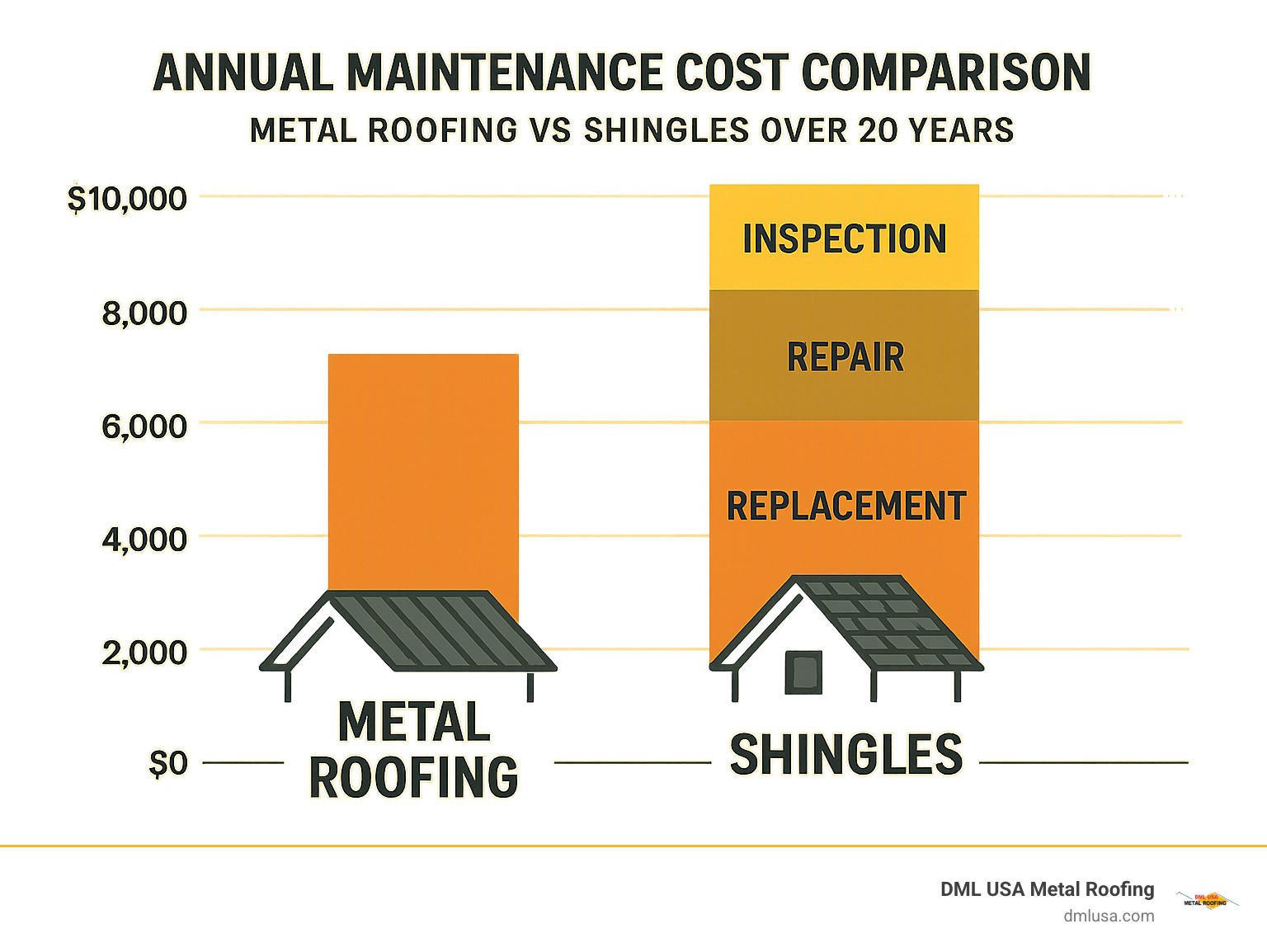
Shingle maintenance demands more attention and expense. Granule loss assessment typically costs $100-200 annually. Individual shingle replacement averages $200-500 per year as wind and weather take their toll. More frequent gutter cleaning runs $150-300 since shingles shed granules. Algae and mold treatment can cost $300-600 in humid climates.
Over 20 years, asphalt shingle maintenance typically costs $4,000-8,000 more than metal roofing maintenance – enough to buy a nice car or fund a family vacation.
When Repairs Become Necessary
Asphalt shingle repairs offer the advantage of easy individual replacement. However, finding matching shingles becomes nearly impossible as your roof ages and fades. This often forces homeowners to replace entire roof sections to achieve uniform appearance.
Metal roofing repairs typically involve panel replacement or fastener adjustment. While individual repairs might cost more upfront, they happen far less frequently and usually maintain better aesthetic consistency.
For more information about our metal roofing products and their maintenance requirements, visit our products page.
Conclusion
After weighing all the facts, it’s clear that the metal roofing compared to shingles discussion is really about what matters most to you as a homeowner. Think about your timeline, your budget, and what kind of peace of mind you want overhead—literally!
If you’re planning to stay in your home for more than 15 years, metal roofing is tough to beat. The long-term value, the chance to save on energy bills and insurance, and the satisfaction of making an environmentally responsible choice all stack up in your favor. Metal roofs weather storms, wildfires, and the test of time—while keeping your home cooler in summer and helping you sleep a little easier during severe weather. For many folks, choosing metal means this could be the last roof you’ll ever need.
Of course, asphalt shingles still have their place. Maybe you’re only planning to stay put for a few years, or your neighborhood’s HOA has strict guidelines about roof appearance. Or maybe you like the idea of a weekend DIY project (and don’t mind doing it again in fifteen years). Shingles usually mean less up-front cost and are a familiar choice for many.
At DML USA Metal Roofing here in Illinois, we’ve been making high-quality, affordable metal roofing since 2007. Our roofs are designed for low maintenance, high durability, and superior resistance to fire, wind, and hail. Plus, you may be eligible for energy tax credits—another reason to smile when the utility bill comes.
Let’s be honest: All those numbers add up. Over 50 years, metal roofing can save you upwards of $24,000 compared to shingles, and homes with metal roofs can recover as much as 85-95% of installation costs at resale. That’s on top of enjoying a quieter, safer, and more energy-efficient home.
As weather grows more unpredictable and environmental concerns keep rising, making the move from shingles to metal is less about “roof wars” and more about future-proofing your investment. In almost every way that matters, when you look at metal roofing compared to shingles, metal comes out ahead for durability, savings, and peace of mind.
Ready to explore if a metal roof is right for you? Find more about the benefits on our why choose metal roofing page.
Choosing your next roof can feel like a big decision—but when you compare metal roofing to shingles for a whole lifetime, the math (and the comfort) is on metal’s side.