

Metal Roofing Square Foot Cost 2025: Top 5 Powerful Savings
Understanding Metal Roofing Costs: The Price Transparency You Need
Metal roofing square foot cost ranges from $4 to $40 per square foot installed, depending on the material and system you choose. Here’s what you can expect to pay in 2024:
Quick Cost Reference:
– Exposed fastener systems: $4-$8 per sq ft
– Standing seam steel: $12-$16 per sq ft
– Aluminum roofing: $6.50-$21 per sq ft
– Premium copper: $20-$40 per sq ft
– Material only: $1.50-$3.50 per sq ft (steel panels)
If you’re tired of constant roof repairs and high maintenance bills, you’re not alone. Metal roofing offers a one-and-done solution that can last 40-70 years while potentially cutting your energy costs by up to 20%.
But here’s the thing – getting straight answers about pricing in the roofing industry can be frustrating. As one roofing professional noted, “asking what a metal roof costs is like asking what a car costs” – there are simply too many variables to give you a meaningful answer without knowing your specific situation.
The reality is this: Most homeowners pay between $15,000-$25,000 for a complete metal roof replacement on a typical 2,000 square foot home. That’s roughly 2-3 times more upfront than asphalt shingles, but the long-term value often makes it worthwhile.
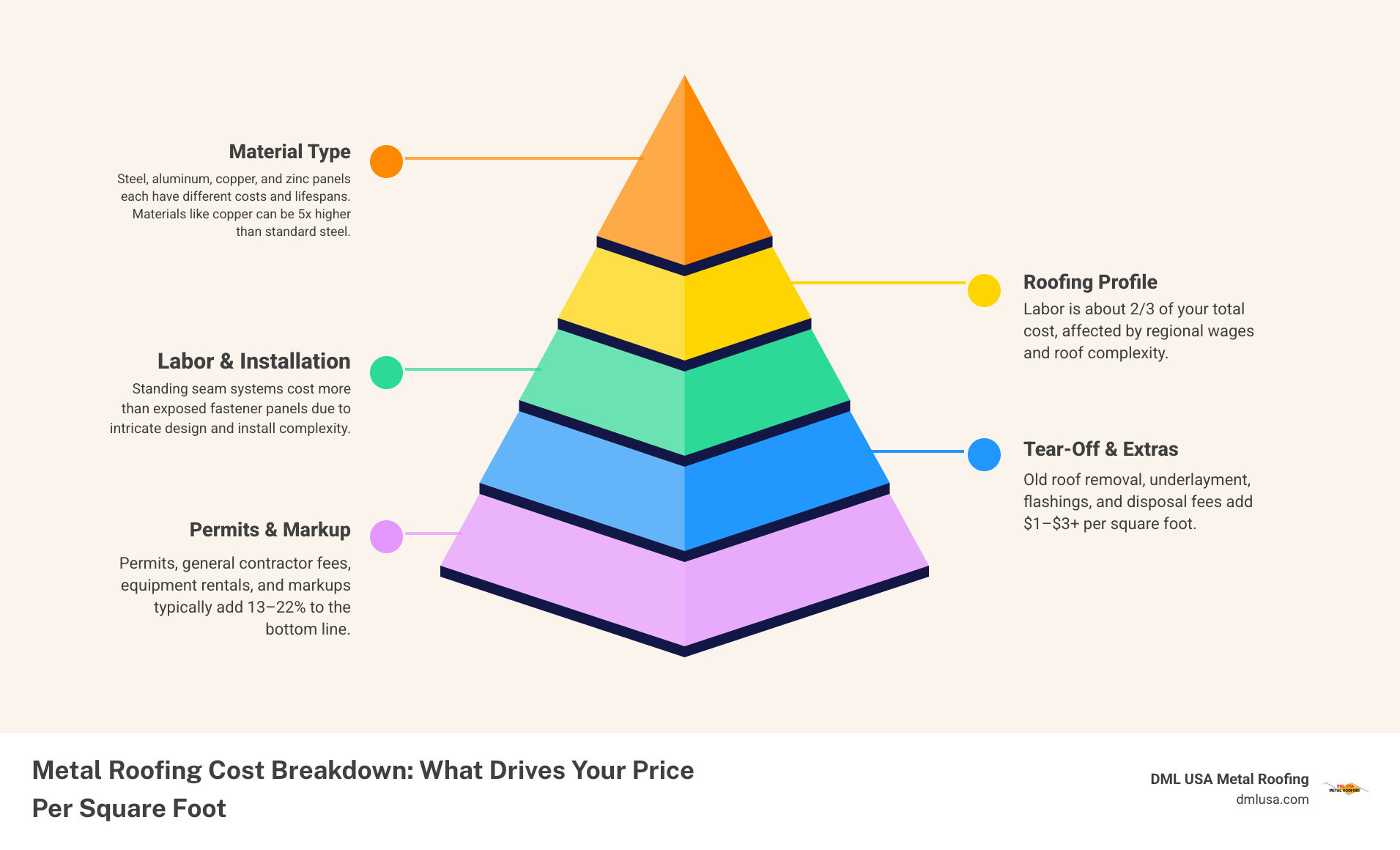
Labor accounts for about two-thirds of your total project cost, and prices vary significantly by region. A standing seam roof in Nashville averages $16 per square foot, while the same system might cost $18+ per square foot in higher-cost markets.
I’m Adam Kadziola, and I’ve spent over 15 years manufacturing metal roofing at DML USA Metal Roofing, helping homeowners understand exactly what drives metal roofing square foot cost in today’s market. My goal is to give you the transparent pricing information you need to make a smart investment in your home’s future.
Metal roofing square foot cost terms at a glance:
– cost difference between metal roof and shingle roof
– metal shingle roof cost
Metal Roofing Square Foot Cost in 2024
When you start looking into a new roof, it’s normal to wonder, “What will this really cost me?” In 2024, the metal roofing square foot cost most often falls between $6 and $16 per square foot installed. That’s quite a range, but it all comes down to which system and metal you choose. For example, standing seam roofs usually run from $12–$16 per square foot, while exposed fastener systems—think barn-style or classic rib—are a budget-friendly $4–$8 per square foot. If you’ve got your eye on something truly special, like copper, you could pay over $20 per square foot.
It’s not just materials driving the price. Labor often makes up about two-thirds of your total project cost. Regional differences—think labor rates, demand, and even shipping—can move your price up or down, too. And yes, inflation has nudged materials a bit higher lately, but metal roofing still holds its value thanks to its long life.
Here’s a silver lining: Scientific research on cool roofs shows that reflective metal roofs can cut your cooling costs by up to 20%. Those energy savings help soften the blow of the upfront investment.
Average metal roofing square foot cost benchmarks
Your budget will depend a lot on the material you choose. Here’s what you can expect for metal roofing square foot cost by material:
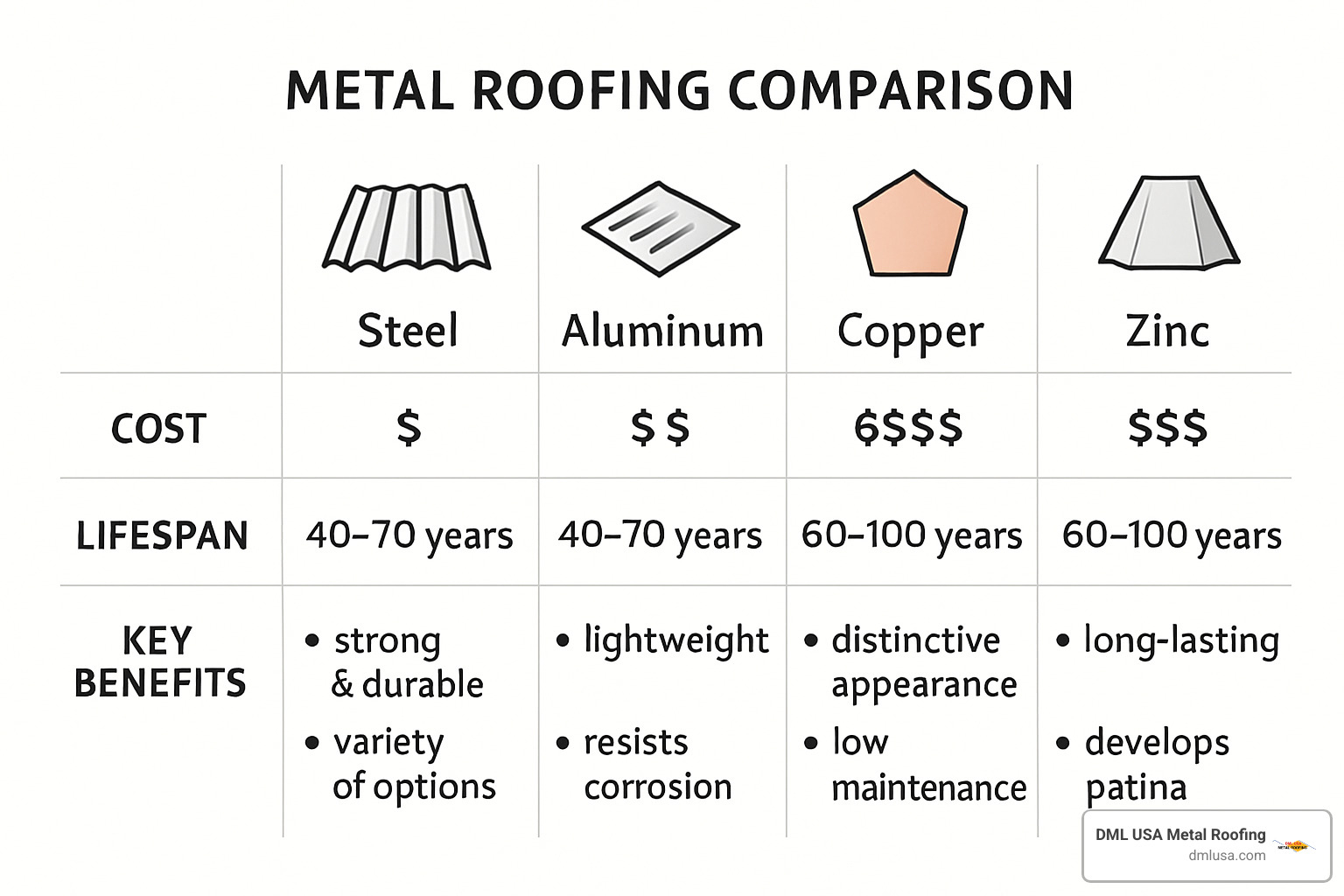
Galvalume Steel—typically $4–$9 per square foot installed—is the go-to for most homes. It fights off rust, looks sharp, and can easily last 40 to 50 years.
If you’re close to the ocean or want something lighter, Aluminum might be your pick. It runs $6.50–$21 per square foot installed, shrugs off salt air, and lasts 50+ years.
Looking for a showstopper? Copper comes in at $20–$40 per square foot installed. It slowly develops that classic green patina and can outlast just about anything—sometimes more than 100 years.
Zinc is another premium choice at $15–$30 per square foot installed. It heals its own scratches and develops a beautiful patina, with a lifespan of 60–100 years.
Material-only vs. installed metal roofing square foot cost
It’s easy to see just the price of the metal sheets and think, “Hey, that’s not so bad!” For raw steel panels, material-only costs are about $1.50–$3.50 per square foot. But after you add in installation (usually $3–$8 per square foot), your total metal roofing square foot cost jumps up.
Don’t forget the extras. Tearing off your old roof and disposing of it adds $1–$3 per square foot. Underlayment is another $0.50–$1.50 per square foot. Flashing and trim run about $2–$5 per linear foot, and you’ll likely need permits too (typically $150–$500, depending on your area).
Let’s put this into perspective. For a typical 2,000-square-foot roof using Galvalume steel panels, you might see:
- Materials: $3,000–$7,000
- Labor: $6,000–$16,000
- Tear-off and disposal: $2,000–$6,000
- Total project cost: $11,000–$29,000
So while the upfront price tag for metal roofing is higher than asphalt, remember: you’re investing in a roof that could last half a lifetime—or more. And with the right choices, you’ll enjoy lower energy bills along the way. Want more on what goes into roofing costs? Take a look at our Resources page for deeper insights.
Key Factors that Drive Your Per-Square-Foot Price
Knowing what really moves the needle on price lets you focus your budget where it matters most.
Panel profile is the single biggest driver. Exposed-fastener panels cost $4-$8 per square foot installed, while concealed-fastener standing seam doubles that. Gauge thickness adds another layer: upgrading from 26- to 24-gauge steel raises material cost 25-40% but gives better dent and wind resistance.
Paint systems matter too. Standard SMP coatings are fine for many homes, but PVDF (Kynar®/Hylar®) keeps color far longer—expect to pay about 30% more up front and avoid repainting later.
Roof pitch and complexity quickly inflate labor. Anything steeper than 4:12, or roofs loaded with valleys, dormers, or skylights, can add $1-$2 per square foot because crews work slower and waste more material.
Location and timing influence both labor and freight. Metro labor rates are higher, remote jobs add delivery surcharges, and peak summer demand bumps prices 10-15%. Booking work in winter often secures lower bids.
Underlayment and flashing are easy to overlook but critical for watertightness. Skimping here may save cents now and cost thousands later.
Exposed Fastener vs. Standing Seam
- Exposed fastener: $4.50-$6.50 per sq ft, fast install, but hundreds of screws—and their rubber washers—remain exposed to sun and movement.
- Standing seam: $12-$16 per sq ft, hidden clips and interlocking seams eliminate those leak points and tolerate expansion better. Scientific research on standing seam benefits backs up the longer life.
Metal Type Impact on Cost & Lifespan
Steel remains the go-to—great strength at a friendly price and 40-50-year life. Aluminum resists salt air and weighs less but starts higher. Copper and zinc command premium prices yet can last a century and develop striking patinas. All four can raise resale value 1-6%.
Labor, Permits & Hidden Extras
Labor usually runs $2-$6 per sq ft. Don’t ignore these typical add-ons:
- Tear-off & disposal: $1-$3 per sq ft, plus dumpster fees.
- Equipment: Scaffolding or a lift for steep roofs adds $500-$2,000.
- General-contractor markup: 13-22% for supervision and insurance.
- Permits/inspections: $150-$800 depending on municipality.
Plan for them upfront to avoid unpleasant surprises. For more detail, visit our Resources page.
Comparing Metal to Asphalt, Tile & Other Roofs
When evaluating metal roofing square foot cost, consider life-cycle costs rather than just upfront expenses. Here’s how metal stacks up against other materials:
| Material | Cost per sq ft | Lifespan | Weight (per 100 sq ft) | Energy Efficiency |
|---|---|---|---|---|
| Metal | $6-$16 | 40-70 years | 70-120 lbs | Excellent |
| Asphalt Shingles | $3-$8 | 15-25 years | 275-425 lbs | Poor |
| Clay Tile | $8-$20 | 50-100 years | 550-1000 lbs | Good |
| Slate | $15-$30 | 75-150 years | 800-1500 lbs | Good |
The life-cycle cost analysis often favors metal roofing. While you might pay $20,000 for a metal roof versus $8,000 for asphalt shingles, the metal roof could last 50 years compared to 20 years for shingles. Over 50 years, you’d need 2-3 asphalt roof replacements, totaling $16,000-$24,000 plus the hassle of multiple installations.
Metal roofing also offers:
– Energy savings: Up to 20% reduction in cooling costs
– Insurance discounts: 5-15% in some areas for fire/wind resistance
– Maintenance savings: Minimal upkeep compared to other materials
– ROI: Studies show 61% return on investment at resale
Why metal often wins despite higher upfront cost
Metal roofing’s higher metal roofing square foot cost often pays for itself through:
Durability Benefits:
– Withstands winds up to 140 mph when properly installed
– Class A fire rating provides maximum protection
– Hail resistance reduces insurance claims
– No rot, insect damage, or moss growth
Cool-Roof Energy Savings:
– Reflective coatings reduce attic temperatures by 10-15°F
– Lower cooling costs in summer months
– Potential utility rebates in some areas
– Qualifies for federal tax credits (check current eligibility)
Environmental Advantages:
– Contains 30-60% recycled content
– 100% recyclable at end of life
– Reduces landfill waste from roof replacements
– Energy efficiency reduces carbon footprint
Low Maintenance:
– No periodic replacement of missing shingles
– Minimal cleaning requirements
– No moss or algae treatments needed
– Gutters may need cleaning less frequently
When other materials may be preferable
Despite metal’s advantages, other materials might be better choices in certain situations:
Budget Constraints:
– If you need immediate replacement but lack funds for metal
– When you plan to move within 10-15 years
– For rental properties where ROI is less important
Historic District Requirements:
– Some areas mandate specific roofing materials
– Architectural review boards may restrict metal options
– Heritage home preservation requirements
DIY Installation:
– Asphalt shingles are more DIY-friendly
– Metal roofing requires specialized tools and skills
– Professional installation is strongly recommended for metal
Aesthetic Preferences:
– Some homeowners prefer traditional shingle appearance
– Certain architectural styles work better with other materials
– Neighborhood consistency considerations
Saving Money Without Sacrificing Quality
It’s absolutely possible to keep your metal roofing square foot cost manageable—without sacrificing the quality or longevity you’re looking for. With a little planning and some smart decisions, you can have a beautiful, long-lasting metal roof and still feel good about what you spent.
If your project is on the larger side (think 1,000 square feet or more), you might qualify for manufacturer direct pricing. This can shave 10-25% off your material expenses compared to smaller jobs, and you’ll often get lower delivery and labor rates per square foot too. If you have multiple buildings—maybe a house, garage, and shed—get them all quoted at once. Bundling like this can help you cross the bulk pricing threshold and keep your total cost down.
Timing also makes a difference. Winter and early spring are considered the off-season for roofers. Fewer jobs mean labor costs can drop 10-15%. Just be sure to plan for possible weather delays if you go this route.
Your material choices are another big lever for savings. For most homes, 26-gauge SMP-coated steel offers the best balance of cost and performance. If you love the look of copper or zinc, consider using them only for accent details—like dormers or entryways—while sticking with steel for the rest. And if you’re open to a natural, unpainted look, Galvalume steel can save you about $0.50-$1.00 per square foot over pre-painted options.
Don’t forget about incentives! Energy-efficient metal roofing may qualify for federal tax credits, and some utilities even offer rebates for cool-roof installations. It’s worth a quick check of local programs before you commit. For more details on the long-term benefits of metal, visit our Why Choose Metal Roofing page.
Smart upgrades that pay back fast
If you’re willing to invest just a bit more upfront, certain upgrades can quickly pay for themselves. Above-sheathing ventilation (ASV), for example, adds around $1–$2 per square foot but can slash your cooling costs by up to 20% and help your new roof last even longer—especially in hot climates.
Premium reflective coatings like PVDF do run 30–40% higher than standard SMP coatings, but they last much longer and resist fading, so you’ll save on future repainting and maintenance. And if solar panels are in your plans (now or someday), ask your installer about solar-ready clamps. They cost just $0.25–$0.50 per square foot during your roof installation—far less than the expense of retrofitting clamps later, and they keep your roof warranty intact.
If you’re looking for a few quick, actionable ways to trim your metal roofing square foot cost, try these:
1. Schedule your project during the off-peak season (winter) for 10–15% labor savings.
2. Bundle multiple structures to reach at least 1,000 square feet and open up bulk pricing.
3. Stick with standard color options to avoid extra charges for custom paint.
Getting an accurate project estimate
Online calculators are a good starting point, but if you want a trustworthy number for your metal roofing square foot cost, you’ll need an expert eye on your roof. Satellite measurement tools can give you a ballpark estimate, but having a professional measure your roof in person ensures you’re budgeting for the right amount—including the usual 10% material waste factor.
Always request at least three itemized bids from reputable contractors. Don’t just look at the bottom line—make sure each quote details the type of metal, gauge, paint system, underlayment, flashing, tear-off and disposal, and warranty coverage. You want apples-to-apples comparisons, not surprises down the road.
Here are some key questions to ask before signing anything:
– What gauge metal and paint system are you using?
– Is the tear-off and disposal of my old roof included?
– What type of underlayment will be used?
– How will you handle flashing and trim?
– What’s included in your warranty?
Ready to get started? For personalized help or to request a quote, reach out to us through our Contact page.
Frequently Asked Questions about Metal Roofing Square Foot Cost
How does roof size affect price?
Larger roofs typically cost less per square foot because fixed expenses—permits, setup, debris haul-off—spread over more area. Crews work faster on big, simple planes, and bulk material orders open up lower rates. Very small jobs (under 500 sq ft) can run 2-3× more per square foot due to minimum charges.
Is standing seam worth the premium?
Standing seam runs $12-$16 per sq ft versus $4-$8 for exposed fasteners, but delivers:
- Hidden fasteners—no gasketed screws to maintain
- Better thermal-movement tolerance
- Lower leak risk and longer warranties
For conditioned living space you plan to keep, the extra upfront cost usually pays off in durability, energy savings, and resale value. For unheated barns or sheds, exposed-fastener systems often suffice.
Do prices vary by region?
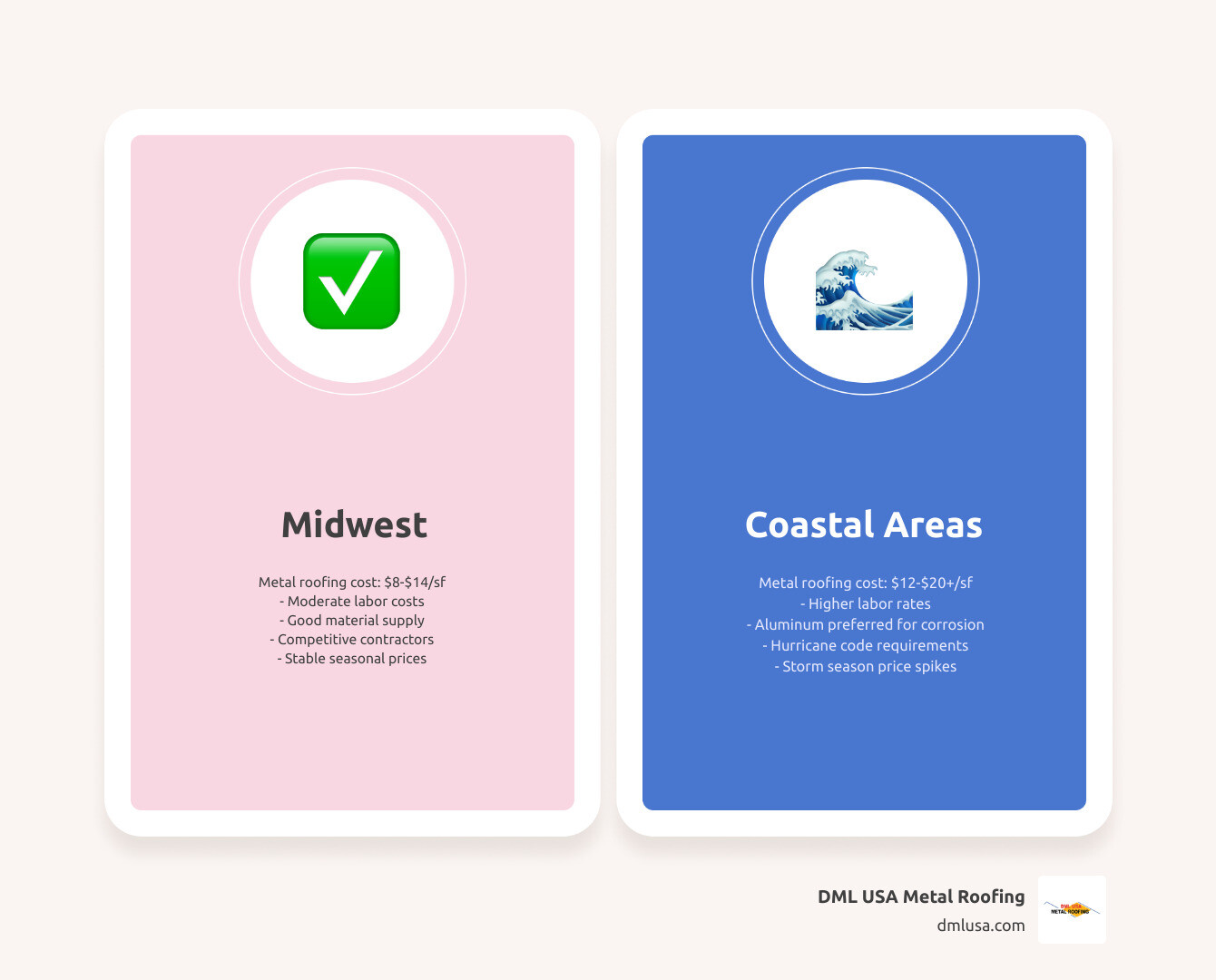
Yes—sometimes dramatically. Midwest markets like Illinois often see total installs in the $8-$14 per sq ft range. Coastal zones pay more for aluminum and hurricane-rated framing, while high-cost metro areas carry steeper labor. Conversely, rural jobs may add freight surcharges. Seasonal timing matters too; winter bookings can shave 10-15% off labor if weather cooperates.
Conclusion & Next Steps
You now have the complete picture of metal roofing square foot cost – and hopefully, it’s clearer than when you started! While that $6-$16 per square foot range might seem wide, you understand why the variations exist and how to steer them smartly.
Here’s the bottom line: metal roofing is an investment that pays dividends for decades. Yes, you’ll spend more upfront than slapping on another layer of asphalt shingles. But when you’re still enjoying your beautiful, maintenance-free roof 40 years from now while your neighbors are on their third shingle replacement, you’ll appreciate the wisdom of that decision.
The one-and-done durability really is the game-changer here. No more Saturday mornings spent cleaning gutters full of shingle granules. No more emergency calls to roofers after every major storm. No more wondering if this is the year you’ll need another expensive roof replacement.
Those energy savings of up to 20% on cooling costs add up quickly too. In today’s world of rising energy prices, a roof that actually helps lower your utility bills feels pretty smart. And if you qualify for tax credits or utility rebates, that’s money back in your pocket right away.
Getting started is straightforward: Measure your roof area, decide whether standing seam or exposed fastener fits your needs and budget, then get three detailed quotes from qualified contractors. Don’t forget to ask about timing – winter installations can save you hundreds or even thousands of dollars.
Labor represents about two-thirds of your total project cost, so choosing the right contractor matters as much as choosing the right materials. Look for contractors who specialize in metal roofing and can explain the differences between systems clearly.
At DML USA Metal Roofing, we’ve spent years perfecting metal panels that deliver exactly what Illinois homeowners need: durability that lasts decades, energy efficiency that cuts bills, and fire resistance that protects families. Our manufacturing expertise means you get professional-grade materials without the premium pricing that comes from multiple middlemen.
Whether you’re finally ready to ditch that troublesome asphalt roof or building new construction, invest wisely in a roofing system designed for the long haul. The higher metal roofing square foot cost today becomes your best home improvement decision when you’re still enjoying that same beautiful roof decades from now.
Your future self will thank you for choosing quality that lasts.